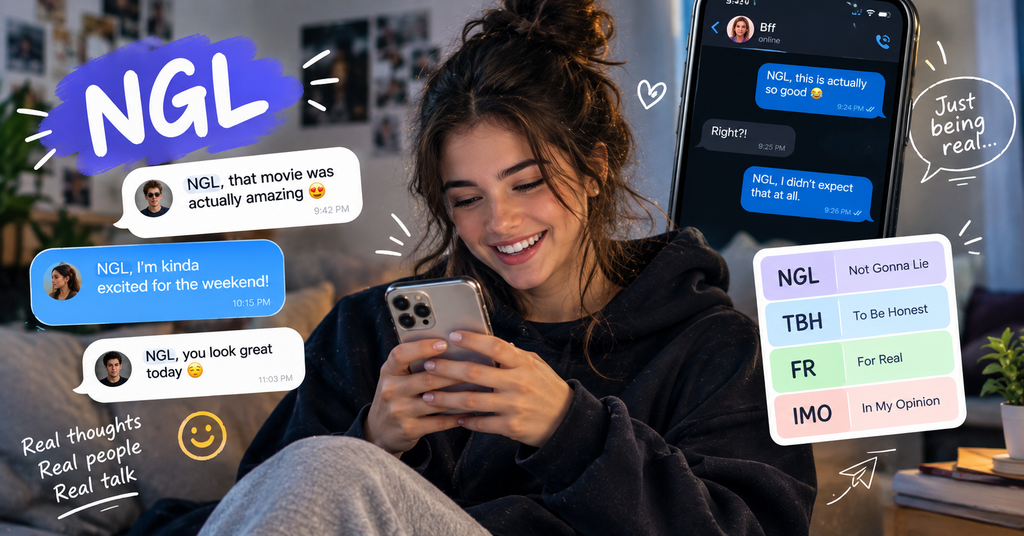
NGL means “Not Gonna Lie.” It’s a casual acronym people use in texts, DMs, and social media comments to introduce an honest opinion, confession, or unfiltered thought. When someone writes “NGL, that movie was amazing,” they’re saying “I’m being real here that movie was amazing.”
If you’ve seen “NGL” in a text message and wondered what it means, you’re in the right place. This guide breaks down exactly what NGL stands for, how to use it naturally, where it came from, and answers the top questions people ask about this Gen Z slang term.
Table of Contents
Quick Answer: What Does NGL Stand For?
| Acronym | Full Form | Meaning |
| NGL | Not Gonna Lie | Introduces honesty, opinion, or confession |
| TBH | To Be Honest | Similar, but slightly more direct |
| FR | For Real | Emphasizes agreement or truth |
| IMO | In My Opinion | Shares a viewpoint politely |
NGL stands for “Not Gonna Lie.” It’s used exactly like the full phrase except faster. People drop it at the start of a sentence to signal they’re about to share something genuine, whether that’s a compliment, a mild roast, or a personal admission.
Example:
- “NGL, I’ve watched that episode three times already.”
- “NGL, your outfit is fire today.”
- “NGL, I didn’t expect to like that song.”
What Does NGL Mean in a Text Message?
When you see NGL in a text message, the sender is keeping it real. It’s their way of saying “I’m about to be honest” without sounding too serious or formal.
Common Uses in Texts
- Honest opinions: “NGL, that restaurant was overrated.”
- Confessions: “NGL, I forgot your birthday.”
- Emotional reactions: “NGL, I kinda miss high school.”
- Playful exaggeration: “NGL, I might cry if they cancel that show.”
Real Text Conversation Examples
Example 1: Casual honesty
Friend: “Did you finish the series?” You: “NGL, I binged it in one weekend.”
Example 2: Giving feedback
Friend: “How was my presentation?” You: “NGL, you nailed the ending.”
Example 3: Vulnerable admission
Friend: “You okay?” You: “NGL, it’s been a rough week.”
The tone depends on context. NGL can be sincere, funny, or even slightly sarcastic but it always signals “this is my real take.”
What Does NGL Mean in Slang?
In slang, NGL is part of the broader internet shorthand that helps people communicate quickly and authentically online. It belongs to the same family as TBH, FR, IMO, and IDK abbreviations that make digital conversations feel more natural and less polished, much like the wider world of Gen Z slang that keeps evolving every year.
Why People Use NGL in Slang
- Saves time – Three letters instead of typing “not gonna lie”
- Sounds casual – Feels like talking to a friend, not writing an essay
- Softens honesty – Makes blunt opinions feel less harsh
- Adds personality – Gives messages a relatable, conversational vibe
NGL is especially popular with Gen Z and younger millennials, who grew up texting and posting on platforms where brevity and authenticity are valued.
NGL vs. TBH: What’s the Difference?
Both NGL and TBH signal honesty, but they carry slightly different vibes.
| Feature | NGL (Not Gonna Lie) | TBH (To Be Honest) |
| Tone | Conversational, casual | More direct, reflective |
| Common use | Opinions, confessions, reactions | Feedback, sincere statements |
| Vibe | “Real talk” | “Here’s my honest take” |
| Example | “NGL, I’m obsessed with this song.” | “TBH, I didn’t enjoy the movie.” |
Key difference: NGL feels more emotional and spontaneous, while TBH sounds slightly more deliberate. You might say “NGL, I’m tired” but “TBH, I think you should reconsider.”
People Also Ask: Top NGL Questions Answered
What Does NGL Mean From a Girl?
NGL means the same thing from a girl: “Not Gonna Lie.” There’s no hidden or gender-specific meaning. If a girl texts “NGL, you’re really funny,” she’s simply being honest just like anyone else would.
Context matters more than gender:
- Compliment: “NGL, you look great today.”
- Confession: “NGL, I was nervous before our date.”
- Opinion: “NGL, that song is kinda overplayed.”
Don’t overthink it—NGL is universal slang, not a secret code.
Why Do People Say NGL?
People say NGL to introduce honesty without sounding too serious. It’s a conversational cushion that makes candid statements feel more relaxed and less confrontational.
Reasons people use NGL:
- To share genuine feelings (“NGL, I’m proud of you”)
- To admit something awkward (“NGL, I ate your leftovers”)
- To emphasize an opinion (“NGL, this is the best pizza ever”)
- To keep things light while being real (“NGL, I almost fell asleep during the movie”)
It’s the digital equivalent of saying “real talk” before dropping a truth.
Is NGL Gen Z Slang?
Yes, NGL is considered Gen Z slang, though it originated earlier. The abbreviation first appeared in early 2000s chat rooms and SMS messaging, then gained mainstream popularity on Twitter, Tumblr, and later TikTok.
Timeline:
- Early 2000s: Used in AIM, MSN Messenger, and early forums
- 2008–2012: Spread on Twitter and Tumblr
- 2015+: Common on Snapchat and Instagram
- 2020+: Staple in TikTok comments and Gen Z vocabulary
While millennials used it first, Gen Z made it ubiquitous across social media platforms, right alongside other viral TikTok trends that shape how young people talk online today.
What Does NGL and TBH Mean Together?
When someone uses NGL and TBH in the same conversation, they’re layering honesty. Both mean the person is being sincere, but they might use them for slightly different purposes.
Example:
“TBH, I wasn’t sure about the plan at first. NGL, though—it ended up being amazing.”
Here, TBH introduces a reflective thought, while NGL adds an emotional, spontaneous reaction. Using both shows the person is being extra genuine.
How to Use NGL Without Sounding Forced
The key to using NGL naturally is to keep it casual and authentic. Don’t force it into every sentence save it for moments when you’re genuinely sharing an honest thought.
Do:
- Use it at the start of a sentence: “NGL, I’m impressed.”
- Pair it with real emotions: “NGL, that made me laugh so hard.”
- Keep it conversational: “NGL, I’ve had this song on repeat.”
Don’t:
- Overuse it (every other sentence feels try-hard)
- Use it in formal settings (emails, work chats, academic writing)
- Pair it with obvious lies (“NGL, I’ve never eaten pizza” – really?)
Natural examples:
- “NGL, I didn’t think I’d like this restaurant, but wow.”
- “NGL, you’re the best study partner I’ve had.”
- “NGL, I’m already counting down to the weekend.”
If you’re already comfortable using NGL, you’ll probably pick up other casual phrases fast too, like when someone says they’re totally locked in on a task or goal.
When NGL Might Be Misunderstood
Even though NGL is straightforward, tone can get lost in text. Without facial expressions or voice inflection, some messages might come off harsher than intended.
Potentially risky uses:
- “NGL, that wasn’t your best work.” (Could sound critical)
- “NGL, I expected more.” (Might feel like a roast)
- “NGL, you’re kinda wrong about that.” (Can seem confrontational)
How to soften it:
- Add an emoji: “NGL, that wasn’t your best work 😅”
- Follow with something positive: “NGL, that wasn’t your best work, but I know you’ll nail the next one.”
- Use in playful contexts with friends who know your tone
Also note: In professional or scientific contexts, NGL can mean “Natural Gas Liquids” completely unrelated to slang. Stick to casual chats to avoid confusion. And just like a blunt NGL comment can land wrong, using slang like crash out at the wrong moment can also come across more serious than intended.
Where You’ll See NGL Used
NGL appears across all major platforms, especially where quick, casual communication is the norm.
| Platform | How NGL Is Used |
| Text messages | Honest admissions, opinions, reactions |
| Instagram captions | “NGL, this took 20 tries to get right” |
| TikTok comments | “NGL, this sound hits every time” |
| Twitter/X | Hot takes and candid thoughts |
| Snapchat | Quick, real-time confessions |
| DMs | Personal, vulnerable messages |
It’s especially common in Gen Z spaces like TikTok, where authenticity and relatability drive engagement the same spaces where terms like cooked blow up overnight.
Related Slang Terms You Should Know
If you’re building your internet slang vocabulary, here are terms that often appear alongside NGL:
- TBH – To Be Honest (direct sincerity)
- FR – For Real (strong agreement or emphasis)
- IMO/IMHO – In My (Humble) Opinion (polite viewpoint)
- IDK – I Don’t Know (uncertainty)
- NVM – Never Mind (dismissing a previous statement)
- FYI – For Your Information (sharing info)
- IKR – I Know, Right? (agreement)
Knowing these helps you read and write texts like a native digital communicator. If you want to go deeper into more aggressive internet acronyms, terms like SYBAU are worth understanding too, even if they’re a bit harsher in tone.
Final Thought: Why NGL Matters in Modern Communication
NGL might seem like just another three-letter acronym, but it reflects something deeper about how we communicate today. In an age of curated Instagram feeds, polished TikToks, and carefully crafted online personas, NGL is a small rebellion toward authenticity. It’s a way of saying “forget the filter here’s what I actually think.”
That’s why it’s stuck around for over two decades and shows no signs of fading. Whether you’re Gen Z, a millennial trying to keep up, or just someone who wants to understand modern texting culture, knowing what NGL means helps you connect more genuinely in digital conversations.
The beauty of NGL is its simplicity. No complicated rules, no hidden meanings just three letters that cut through the noise and say “this is real.” And in a world full of performative posts and surface-level interactions, that kind of honesty is refreshing, kind of like how playful terms such as aura points turn everyday moments into something fun to talk about online.
So the next time you’re typing out a text and want to share something genuine, don’t hesitate to drop an NGL. Just remember: with great honesty comes great responsibility. Use it wisely, keep it kind, and let your real personality shine through.
FAQs
What does NGL stand for?
NGL stands for “Not Gonna Lie.” It’s used to introduce honest statements in casual digital communication.
Is NGL the same as TBH?
Similar, but not identical. NGL feels more conversational and emotional; TBH is slightly more direct and reflective.
Can NGL be used sarcastically?
Yes. People sometimes use it playfully to exaggerate emotions, like “NGL, I might die if this song ends.”
Is NGL appropriate for work or school?
No. NGL is informal slang. Avoid it in professional emails, academic writing, or formal settings.
Where did NGL come from?
NGL originated in early 2000s chat rooms and SMS messaging, then spread through Twitter, Tumblr, and later TikTok. For more breakdowns like this one, check out the full Brain Rot Words blog.