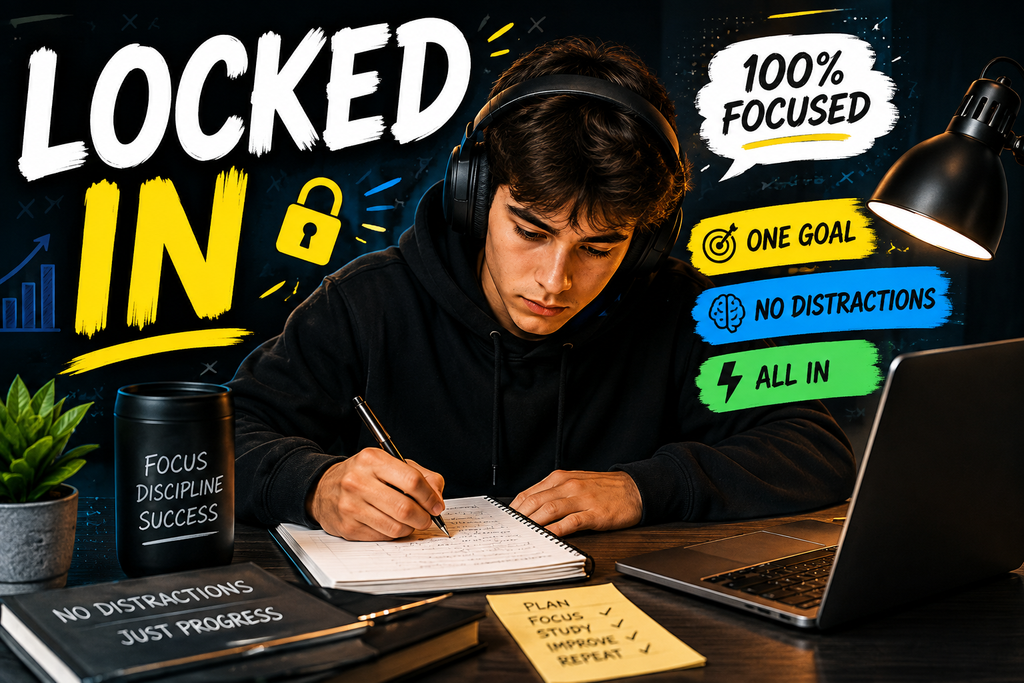
If you’ve scrolled TikTok, sat in a classroom, or texted a partner recently, you’ve probably seen someone say they’re “locked in.” It shows up in gym captions, group chats, relationship posts, and study vlogs — and it means something slightly different in each one.
Quick answer: In slang, “locked in” means being fully focused, committed, or dialed into something, with no distractions pulling your attention away. Depending on context, it can describe intense concentration (studying, working, competing), emotional commitment (a relationship or friendship), or simply being fully present and engaged in the moment.
Here’s a full breakdown of what it means, where it comes from, and how to use it correctly in different situations.
Table of Contents
“Locked In” Meaning: The Core Definition
At its core, “locked in” describes a state of complete focus or commitment — mentally, emotionally, or both. Merriam-Webster’s Slang Dictionary defines it as taking on a task or goal that requires intense concentration, and that’s the meaning most people default to when the context isn’t romantic or social.
Think of it as the opposite of being scattered, distracted, or half-present. If you’re “locked in,” you’ve mentally shut the door on everything else and committed to the one thing in front of you — whether that’s a final exam, a workout, a project deadline, or a person.
Where Did “Locked In” Come From?
The phrase isn’t a brand-new invention, even though it exploded in popularity through TikTok and Instagram meme culture starting around 2023. Slang trackers point to usage dating back to at least 2009, well before it became a Gen Z catchphrase — Gen Z popularized the format and the memes, but didn’t invent the underlying phrase.
The imagery behind it is straightforward: “locked” evokes something fastened shut, unable to move or be pulled away — and applying that to focus suggests your attention is fastened onto one thing, unable to drift. It’s a natural evolution of older phrases like “locked on” (used in sports and military contexts to describe target focus) and “in the zone.”
It’s worth noting the phrase has an older, unrelated meaning too: “locked-in syndrome” is a real medical condition involving paralysis with preserved consciousness. That’s a clinical term with no connection to the slang usage — context makes the difference obvious, but it’s a good example of how the same words can carry completely different weight depending on where you encounter them.
You will find our this guide more interesting: BrainRot Words Parents Should Know: A Guide to Gen Z and Gen Alpha Slang
What Does It Mean When Someone Says “I’m Locked In”?
When someone says this about themselves, they’re announcing total focus and commitment to a task, usually in the moment or for a defined stretch of time. Common contexts include:
- Studying or work: “I’m locked in for finals week” means distractions are off the table until the task is done.
- Sports and gaming: A commentator might say a player is “locked in” after a string of good plays — fully in rhythm, not missing a beat.
- Fitness and discipline: “Locked in on my diet” signals strict, no-excuses commitment to a goal.
- General self-improvement: Phrases like “the lock-in” (sometimes capitalized) have been used to describe a stretch of months — often September through December — dedicated to getting serious about goals after a more relaxed summer.
In all of these, the emotional flavor is the same: seriousness, discipline, and tuning out everything that isn’t the priority.
What Is “Lock In” in Gen Z Slang?
Among Gen Z specifically, “lock in” (often used as a command — “lock in!”) functions as a rallying cry to focus, similar to “get serious” or “stop slacking.” It’s frequently used self-deprecatingly or as encouragement between friends, and it’s become a meme format in its own right, often paired with intense or exaggerated imagery to comedically emphasize extreme focus.
While Gen Z is responsible for turning it into a viral, endlessly remixed phrase, the underlying meaning hasn’t changed much from its earlier, quieter usage — it’s the volume and reach that are new, not the concept.
“Locked In” Meaning in a Relationship
In a romantic context, “locked in” shifts slightly from focus to commitment. Here, it typically means:
- Being exclusive with a partner — not seeing or entertaining anyone else.
- Being fully invested emotionally, giving your time, attention, and energy to that one relationship rather than splitting it elsewhere.
- Signaling that both people are on the same page about the seriousness of the relationship, even without a formal label like “boyfriend” or “girlfriend.”
It’s a slightly more casual way of saying “we’re serious” or “we’re exclusive,” often used before a couple has had an explicit “define the relationship” conversation. Saying “we’re locked in” can function almost like a soft commitment milestone — less formal than dating officially, but clearly past the ambiguous, casual stage.
One important nuance that comes up often: being “locked in” in a relationship generally requires both people to feel the same way. If only one partner is genuinely locked in while the other isn’t, the term is frequently used (especially in relationship advice content) to describe an imbalance that tends to cause problems down the line.
What Does “We Locked In” Mean?
“We locked in” is simply the plural, shared version of the phrase, and its meaning shifts depending on who’s saying it and about what:
- Between partners: “We locked in” usually confirms mutual exclusivity or serious commitment — both people are choosing each other and not keeping other options open.
- Between friends or teammates: It can mean the group is aligned and fully committed to a shared goal, like a project, competition, or plan — “we locked in for the tournament” means everyone’s taking it seriously.
- In casual, low-stakes contexts: It can be as simple as confirming a plan is set — “we’re locked in for Friday” just means the plan is finalized and everyone’s committed to showing up.
Context does most of the work here — the phrase itself is flexible, but the core idea of shared commitment stays consistent.
“Locked In” Meaning in Friendship
Friendship uses the same emotional core as the romantic version, minus the exclusivity element. Being “locked in” with a friend typically means:
- A strong, dependable bond — someone who consistently shows up for you.
- Loyalty that holds up through difficult times, not just convenient ones.
- A closeness that feels stable and secure, similar to how the phrase is used for committed relationships, just without romantic implications.
You’ll often see this phrasing paired with “ride or die” energy — the idea that the friendship is a given, not something either person questions.
How to Use “Locked In” Correctly
| Context | Example | Meaning |
| Studying/Work | “I’m locked in until this project’s done.” | Fully focused, no distractions |
| Sports/Performance | “She’s locked in tonight — hasn’t missed a shot.” | In a state of peak focus or performance |
| Relationship | “We’re locked in now, no one else in the picture.” | Exclusive, committed |
| Friendship | “Me and her have been locked in since middle school.” | Deep, loyal, dependable bond |
| Plans | “We’re locked in for Saturday.” | Confirmed and committed to a plan |
A quick way to tell which meaning applies: if the sentence involves a task, goal, or performance, it almost always means focus. If it involves a person or relationship, it almost always means commitment.
Read more: How Gen Alpha Is Changing the Way We Use Language Online
FAQs
What is “lock in” in Gen Z slang?
It means being fully focused and serious about a task, free of distractions. Gen Z popularized the phrase through TikTok and Instagram meme culture, though the term itself predates that popularity by well over a decade.
What does it mean when you’re “locked in”?
It means you’re completely focused, committed, or dedicated to something — a task, goal, relationship, or friendship — depending on context. The common thread across all uses is undivided attention and seriousness.
What does it mean for someone to be “locked in”?
It means that person is fully dedicated and not distracted or half-committed. In a task context, it describes concentration; in a relational context, it describes emotional commitment and loyalty.
What does “we locked in” mean?
It means two or more people are mutually committed — to each other in a relationship, to a shared goal with friends or teammates, or simply to a confirmed plan, depending on the situation.