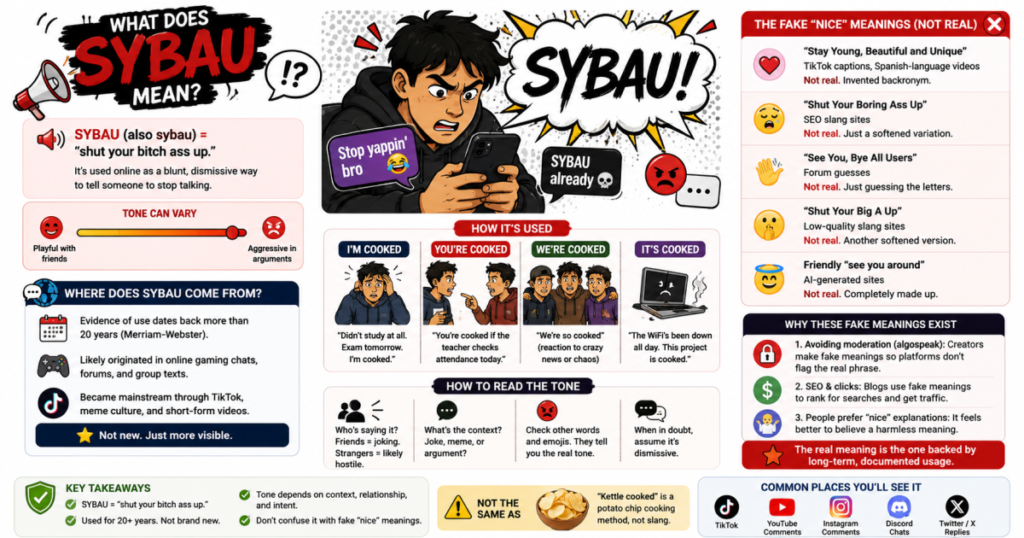
SYBAU is an internet slang acronym that stands for “shut your bitch ass up,” used as an aggressive, dismissive way to tell someone to stop talking, whether seriously or as a joke. It shows up constantly in comment sections, group chats, and memes, and while it sounds brand new, evidence of its use online goes back more than 20 years.
If you’ve seen “SYBAU” dropped into a reply and aren’t sure whether it’s a real insult, a joke, or something wholesome and misread, you’re not alone and you’re not wrong to be confused. There’s a genuine wave of fake, sanitized “meanings” for this acronym spreading across TikTok and low-quality slang sites right now, and sorting fact from fiction here actually requires some real digging. This guide covers the accurate definition, where it came from, why the fake “nice” versions exist, how it’s used in memes, and how to read the tone of a message that uses it.
Table of Contents
What Does SYBAU Mean?
SYBAU (also written sybau, lowercase) is an abbreviation for “shut your bitch ass up.” It’s used online as a blunt, dismissive way to tell someone to stop talking, the internet-slang equivalent of “shut up,” turned up several notches in intensity. According to Merriam-Webster, which added an entry for the term, evidence of its use dates back more than two decades, even though it feels like a term that appeared out of nowhere in the last year or two.
The tone varies a lot depending on who’s saying it and to whom. Between close friends trading jokes, it can be almost affectionate the digital version of telling a friend to shut up because they said something ridiculous. Aimed at a stranger in a comment section during an argument, it reads as a genuine insult intended to shut down the conversation.
Where Does SYBAU Actually Come From?
This is where most existing guides fall short; they treat SYBAU as if it appeared out of nowhere on TikTok in the last year or two. That’s not accurate. Merriam-Webster’s own research notes that evidence of the phrase’s use dates back more than 20 years, which puts its roots well before the current wave of TikTok slang, likely in earlier online gaming and forum culture, where blunt, aggressive shorthand for “shut up” has circulated for a long time in one form or another.
What changed recently isn’t the phrase itself; it’s the visibility. Short-form video platforms like TikTok, combined with meme formats and reaction culture, took a phrase that used to live mostly in gaming chats, forums, and private group texts and pushed it into mainstream comment sections, where it’s now used across a much wider range of contexts and audiences than it originally was.
This pattern an old piece of slang suddenly going viral decades after it first appeared isn’t unique to SYBAU. Similar things have happened with other slang terms that feel new but actually have a much longer history once you check the record. It’s a useful reminder that “trending” and “brand new” aren’t always the same thing.
The Fake “Nice” Meanings of SYBAU (And Why They Exist)
Here’s the part that makes “sybau meaning nice” and “what is sybau real meaning” such common searches: there’s an active, ongoing wave of invented, sanitized definitions for SYBAU spreading across TikTok captions and low-quality slang blogs. None of them are accurate. Here are the most common fake versions currently circulating, and why they don’t hold up:
| Fake “Nice” Meaning | Where It Shows Up | Why It’s Not Accurate |
| “Stay Young, Beautiful and Unique” | TikTok captions, Spanish-language slang explainer videos | A backronym invented after the fact — no dictionary or linguistic source supports this as the original meaning |
| “Shut Your Boring Ass Up” | Several SEO slang-explainer sites | A softened variation that swaps one word to seem less crude, not the actual documented phrase |
| “See You, Bye All Users” | Confused forum comments | A guess based purely on the letters, unconnected to any real usage history |
| “Shut Your Big A Up” | Low-quality slang sites | Another softened substitution, likely written to avoid using the actual word in an article |
| A friendly, non-committal way to say goodbye (“see you around”) | AI-generated slang-definition sites | Not supported by any real usage examples; appears to be entirely fabricated content |
Why do these fake meanings exist in the first place? A few real reasons:
Platform moderation avoidance (“algospeak”).
Creators and websites sometimes deliberately soften or reinterpret the meaning of a crude term so it’s less likely to be flagged, demonetized, or removed by content moderation systems. This is part of a broader pattern linguists call “algospeak,” adjusting language specifically to get around automated platform filters.
Genuine confusion feeding itself.
Once one confused TikTok explains SYBAU as something wholesome, other confused users treat that video as a source, and the incorrect version spreads through repetition rather than accuracy.
Backronym humor.
Some of the “nice” versions are intentional jokes: people deliberately invent a cute meaning for a rude acronym as a bit, which then gets mistaken for the real definition by people who see it out of context.
Content farms optimizing for softer search intent.
Some low-quality sites appear to have simply guessed at a friendlier meaning to appeal to parents or younger searchers, without checking a real dictionary or usage source first.
The bottom line:
If you’re trying to figure out the real meaning, dictionary sources like Merriam-Webster, which base entries on documented usage evidence, not guesses are far more reliable than a TikTok caption or an unsourced slang blog.
SYBAU Meaning in Memes
Beyond direct arguments, SYBAU has become a meme format in its own right, used less as a literal insult and more as an exaggerated reaction to something absurd, over-the-top, or annoying, similar to how “cooked” or “no cap” get used as reaction shorthand rather than literal statements.
Common meme contexts include:
- Reacting to an oddly specific or unhinged take someone posted, using SYBAU as a dismissive, joking response rather than genuine hostility
- Captioning a video of someone being obnoxious or over-explaining something obvious, using SYBAU as the punchline
- Responding to “well actually” corrections in comment sections, particularly on lighthearted content where the correction feels unnecessary
- Paired with reaction images or characters whose expressions match the “I’ve heard enough” energy of the phrase
In meme form, the phrase usually isn’t meant to be taken as a genuine attack it’s shorthand for “this is too much” or “I don’t need to hear more,” used the way someone might use an exaggerated eye-roll.
SYBAU Meaning: Serious Insult vs. Jokei How to Tell the Difference
Because the same three-letter acronym covers such a wide emotional range, context is everything. Here’s a practical breakdown of what usually signals which tone is intended:
| Signal | Likely Meaning: Joke/Playful | Likely Meaning: Genuine Insult |
| Relationship | Close friends, established banter | Strangers, or someone you’re actively arguing with |
| Surrounding tone | Laughing emojis, lighthearted topic | Caps lock, angry emojis, ongoing argument |
| Topic | Something silly or minor | A genuine disagreement, personal attack, or heated debate |
| Platform pattern | Comment on a funny video, group chat inside joke | Reply in a contentious thread or DM argument |
| Response expected | None — it’s a closing joke | Often escalates the conversation further |
If you’re on the receiving end and unsure, the safest read is to look at everything around the message, not just the acronym itself. The same three letters can mean “haha stop, you’re being ridiculous” or “I am genuinely annoyed with you,” and only the surrounding context tells you which.
Is SYBAU Appropriate to Use?
This depends heavily on your audience, platform, and relationship with the person you’re talking to; it’s worth being deliberate about where you use it.
Generally fine:
- Between close friends who already use casual, blunt language with each other
- In meme captions reacting to content, not directed at a specific person
- In spaces where the audience clearly understands internet slang and crude humor
Worth avoiding:
- Directed at strangers, especially in genuine disagreements; it reads as a real insult, not a joke, without established rapport
- In professional, school, or formal contexts, given the underlying profanity in its full meaning
- Directed at younger children or in spaces where the term’s real meaning wouldn’t be considered age-appropriate
- As a way to shut down a conversation you don’t want to have it tends to escalate tension rather than resolve it
How SYBAU Compares to Other “Shut Up” Slang
SYBAU sits at the more intense end of a long list of internet shorthand for telling someone to be quiet. Here’s how it stacks up:
| Term | Meaning | Intensity | Typical Context |
| SYBAU | Shut your bitch ass up | High | Comment sections, arguments, memes |
| STFU | Shut the f*** up | High | Similar contexts, slightly more universally recognized |
| Zip it | Be quiet | Low | Casual, mild, often joking |
| Hush | Be quiet | Very low | Gentle, often used with children or affectionately |
| Not now | Stop talking about this right now | Low-medium | Deflecting, not necessarily hostile |
| GTFO | Get the f*** out | High | Dismissal, often paired with disbelief or shock |
SYBAU’s specific flavor compared to something like STFU is the added personal jab built into the full phrase it’s not just “be quiet,” it’s a more targeted, character-directed dismissal, which is part of why it reads as sharper in serious contexts and funnier in joking ones, depending entirely on tone.
SYBAU Across Different Platforms
The phrase doesn’t behave identically everywhere it shows up each major platform has developed its own slightly different flavor of usage.
TikTok:
This is where SYBAU has become most visible recently, largely through comment sections and reaction-style content. On TikTok, it’s frequently used as a punchline reply to an obvious or over-explained comment, or as a caption on a video reacting to something absurd. The platform’s quick, punchy comment culture suits the acronym’s brevity well.
Twitter/X:
Usage here leans closer to its original, sharper edge. Merriam-Webster’s own citation record pulls a 2025 example directly from X, used in a dismissive reply during an online disagreement about a movie. On X, SYBAU tends to appear in threads where people are already arguing, functioning as a conversation-ending jab rather than a lighthearted joke.
Discord and gaming chats:
This is likely closer to the term’s older roots, given its documented 20-plus-year history. In gaming communities, blunt, aggressive shorthand for “be quiet” has circulated for a long time, often exchanged between teammates during competitive matches, sometimes as genuine frustration and sometimes as trash talk between friends.
Instagram and BlueSky:
More similar to TikTok’s usage, often deployed in captions or replies reacting to unrelated, sometimes wholesome content, treated as an exaggerated, ironic response rather than a literal demand. One documented BlueSky example uses it to dismiss a food-related video that veered into unrelated relationship content, treating the acronym almost like a groan rather than a genuine insult.
The pattern across platforms:
The more anonymous and argument-heavy a space is, the closer SYBAU stays to its literal, aggressive meaning. The more caption- and meme-driven a space is, the more it drifts toward exaggerated, ironic humor.
How to Respond If Someone Says SYBAU to You
If you’re on the receiving end and not sure how to react, a few practical approaches:
Read the surrounding conversation first.
A single word rarely tells you the full story — check what was said right before it and the general tone of the exchange.
Consider your relationship with the sender.
The same phrase from a close friend mid-joke and a stranger mid-argument carries very different weight.
If it’s clearly playful, playing along or laughing it off usually de-escalates things fastest.
Matching the joking tone tends to end the exchange on good terms.
If it’s clearly hostile, disengaging is often the better move than escalating.
Because the phrase itself is designed to shut a conversation down, continuing to argue rarely leads anywhere productive.
If you’re a parent or unfamiliar with the term and it’s directed at you or your child in a way that feels genuinely hostile, it’s worth having a direct conversation about it
rather than assuming it’s automatically one of the more wholesome fake meanings circulating online.
Why Old Slang Keeps Going Viral as “New”
SYBAU’s 20-plus-year documented history, resurfacing as viral “new” slang, isn’t an isolated case — it’s part of a broader, well-documented pattern in how internet language spreads. Terms often exist quietly within specific communities (gaming forums, particular regional dialects, niche online subcultures) for years or even decades before a single viral moment a popular video, a widely shared post, a meme format pushes them into mainstream visibility all at once.
This matters for understanding slang generally: virality and novelty aren’t the same thing. A term “blowing up” online tells you about its current visibility, not necessarily its age. Checking a term’s actual documented history, rather than assuming based on how suddenly it seemed to appear in your own feed, is a more reliable way to understand where a piece of slang actually comes from which is exactly why dictionary sources that track usage evidence over time are more trustworthy here than a viral TikTok’s confident-sounding explanation.
Common Misconceptions About SYBAU
“SYBAU stands for something wholesome like ‘Stay Young, Beautiful and Unique.'”
This is a fabricated backronym with no basis in the term’s actual documented usage or origin the real meaning is confirmed by dictionary sources tracking real usage evidence.
“SYBAU is brand-new Gen Z slang from the last year or two.”
Evidence of the phrase’s use online reportedly goes back more than 20 years, according to Merriam-Webster’s research its recent spike is about visibility on short-form video platforms, not a new invention.
“SYBAU always means someone is genuinely angry.”
It’s frequently used as a lighthearted joke between friends, closer in spirit to playful trash talk than a real attack tone and relationship context determine which it is.
“There’s one universally agreed meaning across every platform.”
While the dictionary-confirmed meaning is consistent, plenty of confused or joking alternate “definitions” circulate online, which is exactly why searches like “what is sybau real meaning” exist in the first place.
“Because it’s crude, it’s always meant as a serious insult.”
Plenty of slang terms carry profanity in their literal expansion while functioning more like punctuation than a genuine attack in everyday use SYBAU is a clear example of that pattern.
Pros and Cons of Using SYBAU
Pros
- Effective, blunt shorthand that instantly communicates “I’m done with this conversation”
- Recognized widely enough now that most people online will understand the reference
- Works well as a lighthearted joke among friends who already use casual, blunt language
- Fits naturally into meme and reaction culture without needing extra explanation
Cons
- Easily misread as a genuine, harsh insult by people unfamiliar with the joking usage
- Not appropriate for professional, school, or formal contexts given its underlying profanity
- Can escalate rather than de-escalate a tense conversation if used with someone who takes it seriously
- The wave of fake “nice” meanings online means some people using it may not actually know what it stands for, leading to awkward misunderstandings
Notable SYBAU Moments Online
A few documented usage examples help illustrate just how differently the acronym reads depending on context:
- A movie discussion on X (2025): one user dismissed another’s overly serious take on a film with “SYBAU it’s a movie not a documentary you weirdo lmao” a clear example of the term used as an exaggerated, mocking response to someone taking something too seriously, rather than a genuine attack.
- A food-content complaint on BlueSky (2025): a user used “Sybau, I’m here for recipes” to express annoyance at cooking videos that veered into unrelated relationship drama using the term almost like an exasperated sigh rather than direct hostility toward a specific person.
- A dismissive one-word reply on X (2025): in response to someone saying “google me,” another user simply replied “girl, sybau” a short, punchy dismissal that reads as playful mockery rather than genuine anger, given the low-stakes nature of the exchange.
These examples share something in common: none of them involve the literal, word-for-word meaning being taken seriously by either party. That’s a useful pattern to recognize in most real, documented usage, SYBAU functions as a tone marker (frustration, mockery, exasperation) more than as a literal command anyone expects to be followed.
Regional and Community Variation
Slang rarely spreads evenly, and SYBAU is no exception. Usage intensity and tone can shift depending on the specific online community:
- Meme and reaction communities (TikTok comment sections, meme pages) tend to use it in its most exaggerated, least literal sense closer to comedic punctuation than a real statement.
- Competitive gaming communities, where a version of this kind of blunt language has circulated for over two decades, tend to use it with more genuine edge, especially during heated matches.
- Fandom and stan communities, particularly around movies, music, and celebrities, often use it defensively in response to criticism of a favorite artist or franchise, blending genuine annoyance with performative drama.
- General social media arguments (politics, contentious opinions, replies from strangers) tend to carry the most literal, hostile version of the phrase’s meaning.
Recognizing which type of community a message is coming from can help clarify intent just as much as the words themselves.
Related Slang Worth Knowing
SYBAU doesn’t exist in isolation it’s part of a broader wave of blunt, dismissive internet shorthand that’s become common in comment sections and reaction culture. A few related terms worth understanding alongside it:
- “Cooked“ used to describe a situation (or person) as doomed or finished, often paired with SYBAU-style dismissiveness in the same conversation
- “Chopped“ slang for unattractive or rough-looking, sometimes combined with other terms into harsher compound insults
- “Algospeak” the broader practice of deliberately altering or softening language to avoid automated content moderation, directly relevant to why some of SYBAU’s fake “nice” meanings exist in the first place
- “Based” used to express approval or agreement, functioning almost as an opposite-energy counterpart to a dismissive term like SYBAU
Understanding how these terms cluster together helps explain why a single reply on TikTok or X can sometimes look like a wall of unfamiliar shorthand each piece is doing a specific, compact job in place of a longer sentence.
A Quick Note on Why This Matters for Parents
If you landed here because a kid or teen in your life said SYBAU and you weren’t sure what it meant, the honest answer is that the real definition includes profanity but in most everyday teen usage, it’s functioning closer to an exaggerated “shut up, oh my god” than a genuinely hostile statement, especially between friends. Context matters here more than the literal words: who said it, who they said it to, and what the conversation was about tell you far more than the acronym alone.
Key Takeaways
- SYBAU stands for “shut your bitch ass up,” a blunt, dismissive internet-slang way to tell someone to stop talking.
- Despite feeling brand new, documented use of the phrase reportedly dates back more than 20 years, according to Merriam-Webster.
- A wave of fake, sanitized “meanings” like “Stay Young, Beautiful and Unique” is spreading online and is not accurate.
- Tone depends heavily on context: between close friends it’s often a joke, aimed at a stranger in an argument it reads as a genuine insult.
- It’s part of a long lineage of “shut up” internet slang, sitting toward the more intense end alongside terms like STFU.
FAQs
What does SYBAU actually mean?
SYBAU stands for “shut your bitch ass up,” a blunt slang way of telling someone to stop talking, used both as a genuine insult and as a joke depending on context.
Is “Stay Young, Beautiful and Unique” the real meaning of SYBAU?
No this is a fabricated, sanitized backronym that has spread on TikTok and low-quality slang sites; it has no basis in the term’s documented usage, which dictionary sources confirm is “shut your bitch ass up.”
Is SYBAU a new slang term?
Not really evidence of the phrase’s use online reportedly dates back more than 20 years, according to Merriam-Webster, even though it’s only recently become widely visible through short-form video platforms.
Is SYBAU always meant as an insult?
Nobetween close friends, it’s frequently used as a lighthearted joke or exaggerated reaction rather than a genuine attack; tone and relationship context are what determine the real meaning in any given message.
Why are there so many different explanations of what SYBAU means online?
A mix of platform-moderation-avoidance (“algospeak”), genuine confusion spreading through repeated misinformation, and intentional backronym jokes has led to several inaccurate “nice” versions circulating alongside the real, documented meaning.