
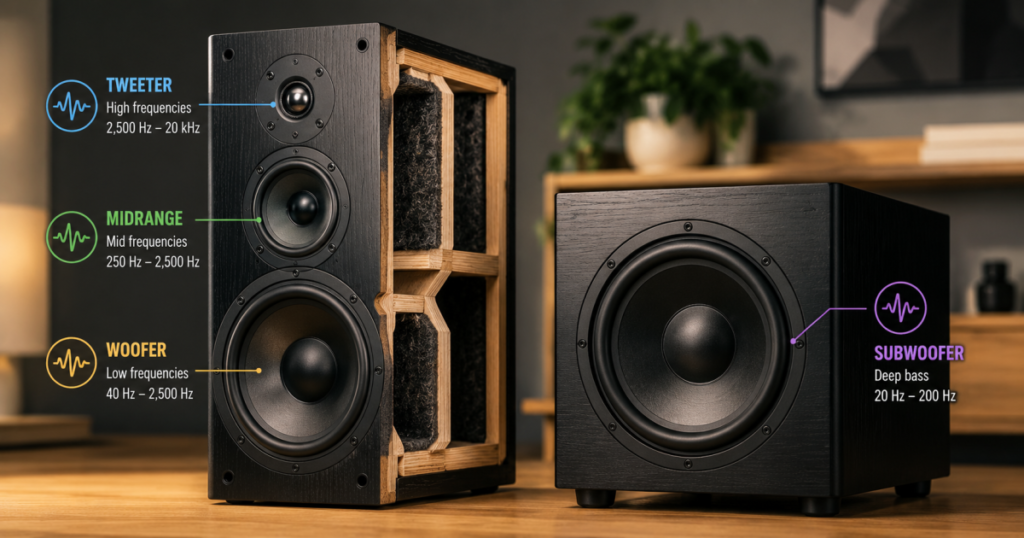
Quick Answer: A woofer is a type of loudspeaker designed to reproduce low-frequency and low-to-mid-range sounds, roughly 40 Hz to 2,500 Hz, such as bass guitar notes and kick drums. It’s typically one driver within a larger speaker, working alongside a tweeter (for high frequencies) and sometimes a midrange driver. In internet slang, “woofer” has also come to mean a big, lovable dog.
Key Takeaways
- A woofer is a loudspeaker driver built to reproduce low and low-to-mid frequencies, generally in the 40 Hz to 2,500 Hz range.
- The name comes from “woof,” the onomatopoeia for a dog’s low bark, since that sound sits in a woofer’s frequency range.
- A subwoofer is a specialized, standalone speaker focused only on the very lowest frequencies, roughly 20 Hz to 200 Hz, and needs its own enclosure and often its own amplifier.
- Woofers are typically 4 to 12 inches in diameter and sit inside a multi-driver speaker; subwoofers are usually larger (8 to 21+ inches) and housed separately.
- In casual internet slang, especially in dog meme culture, “woofer” affectionately means a large dog. An older, separate slang sense uses “woofer” to describe someone who talks a lot without saying much.
- You generally don’t need both a woofer and a subwoofer to hear bass, but combining them, as most home theater and hi-fi systems do, produces fuller, more accurate low-end sound.
What Is a Woofer?
A woofer is a loudspeaker component specifically engineered to reproduce low-frequency sound, including bass notes, kick drums, and the lower range of a human voice. It’s typically the largest driver inside a standard speaker cabinet, paired with a smaller tweeter that handles high frequencies and, in more advanced designs, a midrange driver in between.
Most woofers cover a range of roughly 40 Hz up to 2,000–2,500 Hz, depending on the specific speaker design. That’s a wide span, which is why woofers are sometimes described as “generalists”: they don’t just play the deepest bass, they also carry a meaningful chunk of the midrange, giving music its sense of punch, warmth, and body.
Where Does the Word “Woofer” Come From?
The word woofer comes from “woof,” the classic onomatopoeia for a dog’s low, deep bark. Early audio engineers borrowed the term because a dog’s bark sits squarely in the low-frequency range that this type of speaker reproduces. It’s a fitting, slightly playful bit of naming, especially compared to its high-frequency counterpart, the “tweeter,” named after the higher-pitched chirp of a small bird.
How Does a Woofer Work?
A woofer works like every other dynamic loudspeaker driver, using an electromagnetic system to physically move air and create sound waves.
- An audio signal carrying an electrical current flows into the woofer’s voice coil.
- The voice coil, wrapped around a magnet, generates a magnetic field that reacts against the driver’s fixed permanent magnet.
- This interaction pushes and pulls the coil, which is attached to the speaker cone.
- The cone moves back and forth, displacing air to create the sound waves you hear.
- Larger, slower movements produce the lower-frequency sounds a woofer specializes in, while smaller, faster movements would be handled by a tweeter instead.
Because low frequencies require moving a larger volume of air, woofer cones tend to be wider and heavier than the ones used in tweeters, which only need small, rapid vibrations to produce high-pitched sound.
Woofer vs. Subwoofer: What’s the Difference?
This is one of the most commonly confused pairs of terms in home audio, and for good reason: subwoofers are technically a specialized type of woofer, not a completely separate category.
| Feature | Woofer | Subwoofer |
| Frequency range | Roughly 40 Hz–2,500 Hz | Roughly 20 Hz–200 Hz |
| Size | Typically 4–12 inches | Typically 8–21+ inches |
| Location | Built into a multi-driver speaker | Standalone unit in its own enclosure |
| Power needs | Lower, often driven by the main amplifier | Higher, frequently needs its own amplifier |
| Job | Covers bass and part of the midrange | Covers only the very deepest bass |
| Works alone? | Yes, can operate independently in a speaker | Usually paired with full-range speakers |
The Simplest Way to Remember the Difference
A woofer is a jack-of-all-trades: it handles bass and reaches up into the midrange to help connect with the tweeter. A subwoofer is a specialist: its entire job is reproducing the deepest, most physically felt bass frequencies, the kind you feel in your chest during a movie explosion or a bass-heavy song. Subwoofers exist specifically to pick up where a standard woofer’s low-frequency output starts to weaken.
What Does a Woofer Do in a Speaker System?
In a typical two-way or three-way speaker, each driver handles a specific slice of the audible frequency spectrum, and the woofer’s job is the low end.
- Two-way speakers (common in bookshelf speakers) pair one woofer with one tweeter, splitting the frequency range roughly in half.
- Three-way speakers add a dedicated midrange driver, letting the woofer focus more narrowly on bass while the midrange driver handles vocals and instruments in between.
Without a functioning woofer, music and movie audio would sound thin and tinny, missing the depth and warmth that low frequencies provide. You’d still hear vocals and higher notes clearly through the tweeter, but bass guitar lines, kick drums, and deep dialogue tones would largely disappear.
What Does a Subwoofer Do?
A subwoofer’s entire purpose is reproducing the lowest frequencies in an audio signal, the ones a standard woofer struggles to output cleanly at high volume. This includes:
- Deep movie effects, like explosions, thunder, or a spaceship rumble
- The lowest notes from a bass guitar or synthesizer
- The physical “thump” you feel in your chest during a concert or action scene
Subwoofers typically connect to a receiver’s dedicated subwoofer output and often include their own built-in amplifier (in “active” or “powered” models), since producing very low frequencies at high volume requires significantly more power than a standard woofer needs.
Do You Need Both a Woofer and a Subwoofer?
Not strictly, but most well-rounded audio systems use both. A standard speaker’s built-in woofer can produce bass on its own, but it will reach its physical limits at the very lowest frequencies. Adding a subwoofer extends the system’s low-frequency range further, resulting in fuller, more accurate sound, particularly for movies, electronic music, and any audio with significant sub-bass content.
Types of Woofers
By Placement and Use
| Type | Common Use |
| Component woofer | Built into home speakers, bookshelf speakers, and floor-standing towers |
| Car audio woofer | Installed in vehicle door panels or dedicated enclosures |
| PA/pro audio woofer | Used in larger venue sound systems, often paired with horn-loaded tweeters |
| Rotary woofer | A less common design using rotating fan blades instead of a cone, requiring less power |
By Power Source
- Passive woofers rely entirely on an external amplifier to drive them.
- Active woofers include a built-in amplifier, more commonly seen in professional audio applications than home speakers.
How to Choose the Right Woofer or Speaker Setup
- Match woofer size to your room. Larger rooms generally need larger woofers or an added subwoofer to fill the space with adequate bass.
- Consider whether you need a dedicated subwoofer. If you primarily listen to vocal-heavy podcasts or acoustic music at moderate volume, a quality woofer alone may be enough. Movie fans and bass-heavy music listeners typically benefit from adding a subwoofer.
- Check the crossover point, the frequency at which your system hands off from the woofer to the subwoofer (or from woofer to tweeter). A well-matched crossover avoids gaps or overlaps in sound.
- Think about placement. Standard woofers, built into your main speakers, usually stay at ear level. Subwoofers are more flexible and are often placed near a wall or corner to reinforce bass output.
- Balance power ratings. Make sure your amplifier or receiver can adequately power the woofer or subwoofer you choose; underpowering a driver can cause distortion, while overpowering it can cause damage.
Pros and Cons: Woofer-Only vs. Woofer Plus Subwoofer
| Setup | Pros | Cons |
| Woofer only (standard speakers) | Simpler setup, lower cost, adequate for most everyday listening | Limited output at the very lowest frequencies |
| Woofer + dedicated subwoofer | Fuller, deeper bass; better for movies and bass-heavy music; frees the main woofer to focus on midrange | Higher cost, more setup and calibration, more physical space needed |
What Does “Woofer” Mean in Slang?
Outside of audio equipment, “woofer” has picked up a couple of informal meanings, and they come from noticeably different corners of internet and spoken culture.
1. A Big Dog (Internet and Meme Slang)
The most common modern slang use of “woofer” is an affectionate term for a large dog, part of the same playful “doggo speak” vocabulary that gave us words like “pupper” and “floof.” This usage spread through pet-focused social media communities, and the connection to the speaker term isn’t a coincidence: “woofer” already sounded like a deep bark, which made it a natural fit for describing a big, deep-barking dog.
Example: “That mastiff down the street is a total woofer.”
2. A Talkative Person Who Says Little (Older Slang)
A separate, older slang sense, documented in specialized slang references, uses “woofer” to describe someone who talks loudly and at length but without saying much of real substance. This usage is far less common today than the “big dog” meaning and shows up mainly in older or regional slang collections rather than everyday conversation.
Example: “Don’t listen too closely to him, he’s just a woofer.”
A Word of Caution on Slang Sources
Slang meanings, especially newer internet ones, spread unevenly and aren’t always consistently documented. The “big dog” meaning is well supported by visible, widespread use across pet-focused social media. Other claimed slang meanings circulating online are less consistently sourced, so it’s worth treating any single crowdsourced entry with some skepticism rather than assuming it reflects broad, common usage.
Common Misconceptions About Woofers
“A woofer and a subwoofer are the same thing.”
They’re related but distinct: a woofer is one driver inside a larger speaker covering a wide frequency range, while a subwoofer is a standalone unit dedicated only to the deepest bass frequencies.
“Bigger woofers always sound better.”
Size affects how much air a driver can move, but overall sound quality depends just as much on the enclosure design, materials, and how well the driver is matched to the rest of the system.
“You need a subwoofer to hear any bass at all.”
Standard woofers already reproduce a solid range of bass on their own; a subwoofer extends and deepens that range rather than being the only source of it.
“More power always means louder, better bass.”
Overpowering a woofer beyond its rated capacity can cause distortion or permanent damage rather than improving sound quality.
“Woofer only refers to speakers.”
In casual conversation and social media, it’s now just as likely to mean a big dog as it is to mean audio equipment.
Frequently Asked Questions
What is a woofer in simple terms?
A woofer is a speaker component built to produce low and low-to-mid frequency sounds, like bass guitar notes and drum beats. It’s usually the largest driver in a standard speaker, paired with a tweeter for higher frequencies.
What does a woofer do that a subwoofer doesn’t?
A woofer covers a broader range, including bass and part of the midrange, while a subwoofer focuses exclusively on the very lowest, deepest bass frequencies that a standard woofer can’t reproduce as effectively.
Do I need a subwoofer if I already have woofers in my speakers?
Not necessarily. Standard woofers can produce solid bass on their own. A subwoofer is worth adding if you want deeper, more physically felt bass, especially for movies, home theater setups, or bass-heavy music genres.
What does “woofer” mean in slang?
In modern internet slang, “woofer” most commonly refers affectionately to a large dog, part of the same playful vocabulary as “doggo” and “pupper.” An older, less common slang meaning describes someone who talks a lot without saying much.
How do I know if my speaker’s woofer is damaged?
Common signs include distorted or crackling bass, a rattling sound at higher volumes, or a noticeable drop in low-frequency output compared to when the speaker was new. If you notice these symptoms, it’s worth having the driver inspected before continuing to use it at high volume, since further use can cause more damage.