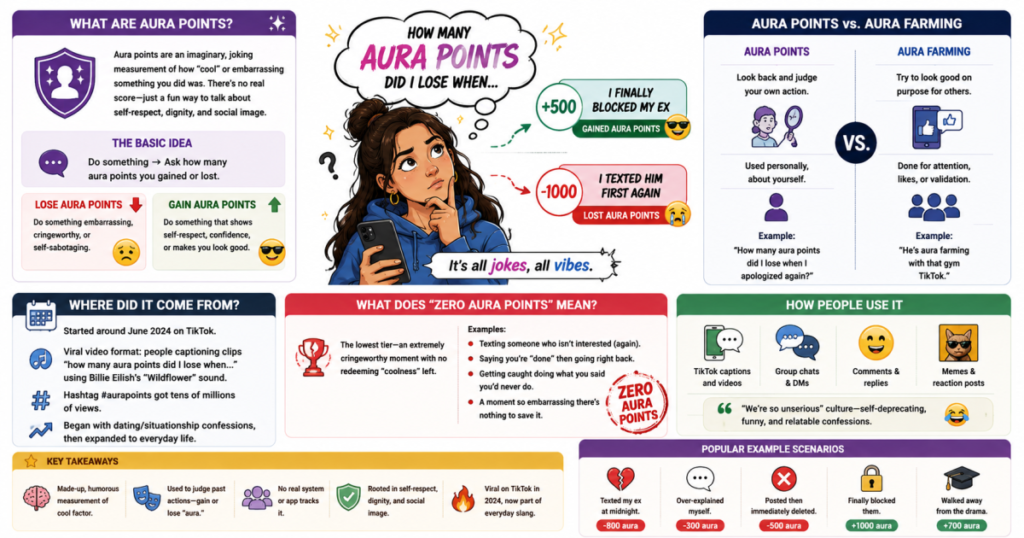
Aura points are an imaginary, joking measurement of how “cool” or embarrassing something you did was, used in TikTok captions like “how many aura points did I lose when…” There’s no real scoring system or app tracking them it’s a made-up, humorous way to talk about self-respect, dignity, and social image, especially around dating and situationships.
If you’ve seen someone caption a video “I think I gained 500 aura points” or “that’s negative aura points,” you’ve run into one of TikTok’s most durable slang formats. It started as a specific viral trend and has since spread into everyday internet vocabulary. Here’s the full picture: what it actually means, where it came from, what “zero aura points” specifically refers to, how it differs from the related term “aura farming,” and how people use it today.
Table of Contents
What Are Aura Points?
Aura points (noun, informal): an imaginary, unofficial measure of how much “aura” cool factor, dignity, and social respect a person gains or loses based on something they did. There’s no real point total, no app, and no agreed-upon scoring rules. It’s a joking framework people apply after the fact to describe how a specific action made them look, usually to themselves.
The format is simple and endlessly reusable: describe an action, then ask (rhetorically) how many aura points it cost or earned. “How many aura points did I lose when I texted him first for the third time in a row?” “How many aura points did I gain when I finally blocked my ex?”
Losing aura points generally means doing something that damages your dignity, self-respect, or “cool” image often something a little embarrassing, self-sabotaging, or cringeworthy. Gaining aura points means the opposite: doing something that reflects self-respect, confidence, or a genuinely admirable choice.
Where Did “Aura Points” Come From?
The trend traces back to around June 2024 on TikTok, built around a specific viral video format. Users would record themselves looking at the camera, then caption the video “how many aura points did I lose when…” or “how many aura points did I gain when…”, filling in the blank with a confession, often something embarrassing tied to a crush, ex, or situationship. The format spread quickly, using a recurring trending sound: a short clip from Billie Eilish’s song “Wildflower” (“I know that you love me, you don’t need to remind me”).
By the time slang explainers started covering it, the hashtag #aurapoints had already racked up tens of millions of views, and the format had expanded well past its original dating-focused roots into general life confessions, work embarrassments, family drama, random daily decisions, anything where someone wanted to humorously self-assess whether they’d made themselves look good or bad.
Why dating and situationships specifically dominate the trend:
Confessing to something embarrassing done for or because of a crush is a uniquely relatable kind of cringe; nearly everyone has done something in pursuit of a crush that, looking back, cost them some dignity. That shared experience is part of why the trend caught on so fast and so widely.
The Underlying Concept: “Aura” as Cool Factor
To understand aura points, it helps to understand what “aura” means in this slang context first. Outside of internet slang, “aura” traditionally refers to a subtle, distinctive quality or energy someone gives off that people pick up on without being able to fully explain it. TikTok’s usage borrows that idea and turns it into something almost gamified: aura becomes a stand-in for overall “coolness,” social capital, or perceived confidence, something that can theoretically go up or down based on specific actions.
This is why “aura points” works as a concept even without real numbers attached; everyone already has an intuitive sense of what makes someone seem more or less “cool” or dignified in a given moment. The joke format just gives that intuition a playful, quantifiable-sounding label.
What Does “Zero Aura Points” Mean?
“Zero aura points” (or sometimes “negative aura points”) refers to hitting a particularly low, cringeworthy moment with essentially no redeeming “coolness” left. It’s used for the most embarrassing tier of confession, distinct from a garden-variety aura-point loss.
Examples of the kind of thing that gets labeled “zero aura points”:
- Repeatedly texting someone who’s clearly not interested
- Publicly declaring you’re “done” with someone and then immediately going back
- Getting caught doing something you specifically said you’d never do
- A situation so embarrassing there’s genuinely nothing redeeming about how it makes you look
The phrase functions as an intensifier, a way of saying “this wasn’t just a minor aura loss, this was the floor.” Some users push the joke further into “negative aura points” or “aura points in the negative billions” for maximum comedic emphasis, since the whole system is understood to be exaggerated and made up in the first place.
Aura Points vs. Aura Farming: Don’t Confuse These
This is the single most common point of confusion around the term, and something most existing explainers skip entirely. Aura points and aura farming are related but genuinely different concepts:
| Term | What It Means | Example |
| Aura points | A retroactive, joking self-assessment of how an action affected your “coolness” | “How many aura points did I lose when I liked his photo from 3 weeks ago” |
| Aura farming | Deliberately doing something often stylish, dramatic, or skillful specifically to look cool or gain perceived “aura” in the moment | A viral clip of a kid steering a boat with an unnaturally composed, stylish expression, widely mimicked as the definitive “aura farming” example |
Aura points are about looking back and grading yourself, usually humorously and often at your own expense. Aura farming is about actively performing for perceived coolness in real time, often used to describe someone (or an edited video of someone) doing something with exaggerated style or swagger, specifically to rack up “aura” in viewers’ eyes.
They share the same underlying “aura as coolness currency” concept, but one is retrospective self-deprecation, and the other is active, often earnest performance. Mixing them up is an easy mistake, since both trended around a similar period and use identical vocabulary.
How to Use “Aura Points” in a Sentence
The format is flexible enough to fit almost any context, but a few patterns cover most real usage:
“How many aura points did I lose when [embarrassing thing]?”
The original, most common format, typically rhetorical and self-deprecating
“That’s [number] aura points right there.”
A direct, declarative reaction to something someone else did
“Zero aura points for that.”
A dismissive, joking judgment of a low-effort or cringeworthy action
“Massive aura points gained.”
Praise for a confident, dignified, or impressive choice
“My aura is in the negatives after that.”
An exaggerated self-own, leaning into the joke format’s inherent silliness
Numbers used in these posts are never meant literally; “500 aura points” and “negative 10,000 aura points” are both jokes, not real point values on any actual scale.
Aura Points in Different Contexts
While the trend started around dating and situationships, it’s since expanded into a general-purpose format across several areas of everyday life:
| Context | Example Use | Typical Tone |
| Dating/situationships | “How many aura points did I lose double-texting my situationship” | Self-deprecating, relatable |
| Friendships | “Gained so much aura standing up for my friend” | Genuine praise |
| Work/school | “Lost all my aura points falling asleep in the meeting” | Embarrassed, joking |
| Family | “Negative aura points for arguing with my mom in the grocery store” | Lighthearted confession |
| Random daily life | “How many aura points did I lose tripping in front of the whole gym” | Purely comedic |
This spread beyond the original dating-focused format is part of why the phrase has stuck around as durable slang rather than fading as a narrow, single-purpose trend; it works as a flexible template for any minor social embarrassment or win.
Is There an Actual Aura Points System?
No, and this is worth stating plainly, since a few lower-quality explainers imply there’s some kind of tracked score. There’s no app, no official rules, no agreed-upon point values, and no consistent scoring logic between different users. Every “aura points” number posted online is invented on the spot for comedic effect, and different people will assign wildly different point values to the same hypothetical situation.
Some brands and creators have leaned into the joke with unofficial “aura point calculators” or quizzes as engagement content, but these are fan-made or marketing gimmicks riffing on the trend, not a real, consistent measurement system the internet collectively uses.
Notable Examples From the Trend
A few illustrative (paraphrased, not verbatim-quoted) examples help show the range the format covers, from its original dating focus to its later expansion:
- A user describing repeatedly liking an ex’s old posts months after a breakup, captioned as a major aura point loss a classic example of the original situationship-confession format.
- A user describing finally deleting a situationship’s number after months of back-and-forth, framed as a major aura point gain, showing the format’s celebratory side, not just the self-deprecating one.
- Posts about non-dating embarrassments: tripping in public, sending a text to the wrong group chat, showing up overdressed to a casual event, demonstrating how far the format spread past its original relationship-focused roots.
- Reaction videos where one person describes another’s confident, composed handling of an awkward situation, awarding them exaggerated “aura points” as a form of praise rather than self-deprecation.
Across all of these, the throughline is the same: aura points work as a flexible shorthand for “this made me look either really good or really bad,” dressed up as a fake scoring system for comedic effect.
Why the Trend Resonated So Widely
A few factors help explain why “aura points” spread as far and lasted as long as it did, compared to countless other short-lived TikTok formats:
Low barrier to participation:
Anyone can make an aura points video it requires no special editing skill, dance, or performance, just a confession and a caption. This made it easy for the trend to spread across creators of wildly different content styles.
Built-in relatability:
Nearly everyone has done something a little embarrassing for a crush, or made a choice they’re quietly proud of standing up for themselves. The format gives people permission to share that publicly, framed as a joke rather than genuine vulnerability.
Flexible, reusable structure:
Unlike trends tied to a specific dance, sound, or visual gag that fades once the novelty wears off, the “how many aura points did I lose/gain when…” sentence structure works indefinitely across new, unrelated situations, which is part of why it outlasted many trends from the same period.
Self-aware humor rather than earnestness:
The trend never asked anyone to take it seriously. That built-in irony everyone understanding the “point system” is fake made it easy to keep reusing without the format feeling stale or forced.
How “Aura” as Slang Evolved Beyond Points
“Aura” itself has become a flexible piece of internet vocabulary well beyond the specific “aura points” trend format. A few adjacent uses worth knowing:
- “No aura” / “he has no aura” describing someone as lacking any distinctive coolness or presence, used as a standalone insult without needing the “points” framing at all.
- “Aura restored” used after someone does something that redeems an earlier embarrassing moment, functioning almost like a sequel to an aura-points confession.
- “Big aura” / “aura is unmatched” general praise for someone’s presence or confidence, disconnected from any specific point-losing or point-gaining action.
- “Aura farming” (covered in detail above) the active-performance cousin of the passive, retrospective “aura points” concept.
This broader spread shows that “aura” itself has become a flexible stand-in for “coolness” or “presence” in internet slang generally, with “aura points” being just one popular, structured format built on top of that underlying concept.
Platform Differences in How the Trend Is Used
While TikTok is where the format originated and remains most visible, usage patterns shift slightly depending on where you encounter it:
TikTok:
Closest to the original format, short video confessions, often using the trending audio, typically first-person and self-deprecating.
Instagram Reels and Stories:
Frequently reposted or recreated versions of TikTok’s format, sometimes with captions applied to unrelated video clips as a joke rather than a genuine confession.
Twitter/X:
More text-based, a tweet describing a situation followed by a joking aura-point estimate, without needing video at all, showing how easily the format translated to a text-first platform.
Group chats and texting:
Used conversationally between friends reacting to something that just happened in real time, “that’s zero aura points” as a quick, spoken-style reaction rather than a formatted post.
This spread across formats and platforms video, text, and casual conversation is part of why “aura points” has held on as genuinely useful slang rather than remaining a single-platform novelty tied to one specific video style.
A Quick Note on Using This Trend Thoughtfully
Because the original trend leans heavily on dating and situationship confessions, it’s worth a brief note on using it with some judgment: sharing genuinely private details about another person (an ex, a crush, a friend) for the sake of an aura-points joke can cross into oversharing about someone who didn’t consent to being part of your content. The format works just as well, arguably better when applied to your own choices and reactions rather than someone else’s private information.
Common Misconceptions About Aura Points
“Aura points and aura farming mean the same thing.”
They’re related, but distinct: aura points are a retrospective, usually self-deprecating self-grade, while aura farming describes actively performing for perceived coolness in the moment.
“There’s a real point system somewhere tracking this.”
There isn’t; every number is invented for the joke, with no consistent rules or shared scale between different posts or users.
“The trend is only about dating.”
It started there but has expanded into a general-purpose format covering friendships, work, family, and random daily embarrassments.
“Zero aura points is just a random low number.”
It specifically functions as an intensifier for the most embarrassing tier of confession, the implied “floor” of the joke’s scale.
“This is brand-new slang that will fade immediately.”
While built on a specific 2024 TikTok trend, “aura” as slang for cool factor has proven durable enough to spread into everyday vocabulary well past its original viral moment.
Aura Points Compared to Similar Slang
Aura points sit alongside a handful of other slang concepts used to describe social image and “coolness,” each with a slightly different flavor:
| Term | What It Measures | Tone | Origin Context |
| Aura points | Retrospective cool-factor self-grade | Self-deprecating or celebratory | 2024 TikTok trend format |
| Rizz | Charisma, especially in a romantic/flirting context | Complimentary or mocking | Broader Gen Z slang, not trend-specific |
| Cool points | Older, pre-internet version of the same basic idea | Playful, generational | Long-standing informal English |
| Aura farming | Actively performing for perceived coolness | Admiring or ironic | 2024-2025 TikTok trend, distinct format |
| Main character energy | Acting with confidence, as if you’re the protagonist of your own story | Celebratory or self-aware | TikTok/internet culture broadly |
The common thread across all of these: internet culture has repeatedly invented playful, quantifiable-sounding language for something inherently subjective: how impressive or embarrassing a person’s actions seem. Aura points is simply the most recent, retrospective-confession-focused version of that pattern.
Pros and Cons of the Aura Points Trend
Pros
- Gives people a lighthearted, low-stakes way to process embarrassing moments through humor rather than genuine shame
- Flexible format that works across nearly any life context, not just dating
- Encourages a kind of self-aware honesty, publicly admitting to cringe moments rather than hiding them
- Easy to understand and join without needing deep trend knowledge
Cons
- Can blur into oversharing personal or relationship details for engagement
- The joking self-deprecation, if taken too seriously, could reinforce genuine insecurity about “looking cool” rather than staying purely humorous
- Easily confused with the separate “aura farming” trend, leading to mixed-up usage
- Like most viral slang, meaning can drift or get diluted the further it spreads from its original context
How to Join the Aura Points Trend
If you want to participate in the original TikTok format rather than just using the phrase casually in conversation:
- Use the trending audio, the short clip from Billie Eilish’s “Wildflower” that anchors the original format, though plenty of newer posts use other sounds or none at all.
- Film a short clip of yourself reacting or looking at the camera, no elaborate production needed.
- Add text on screen following the “how many aura points did I lose/gain when…” format.
- Fill in the blank with something specific and relatable; vague confessions land less well than a precise, detailed moment.
- Lean into the humor rather than genuine embarrassment the format works best when it reads as self-aware and funny, not as a serious confession.
Aura Points and the Broader Pattern of Gamifying Social Life
Aura points fit into a longer-running pattern in internet culture: taking something inherently subjective social image, likability, “coolness” and dressing it up in the language of games, scores, and quantifiable systems. Earlier internet eras had their own versions of this same basic impulse, from informal “cool points” in playground conversation to more structured meme formats built around fake rankings and tier lists.
What makes the aura points format distinct is its retrospective, confessional framing — rather than ranking people against each other, it invites individual self-assessment after the fact, turning everyday embarrassment or pride into shareable, bite-sized content. That structure confess, self-grade, move on maps neatly onto short-form video’s appetite for quick, personal, slightly self-deprecating content, which likely helped it spread as fast and as far as it did.
Key Takeaways
- Aura points are an imaginary, joking measure of how “cool” or embarrassing an action was; there’s no real scoring system behind it.
- The trend traces to around June 2024 on TikTok, built around a specific “how many aura points did I lose/gain when…” video format set to a Billie Eilish audio clip.
- “Zero aura points” specifically describes hitting the most embarrassing, dignity-free tier of a confession.
- Aura points and “aura farming” are related but distinct; one is retrospective self-grading, the other is active performance for perceived coolness.
- The format has expanded well beyond its original dating focus into friendships, work, family, and everyday life confessions.
FAQs
What does “aura points” mean on TikTok?
Aura points are an imaginary, joking measure of how “cool” or embarrassing something you did was, used in the viral “how many aura points did I lose/gain when…” video format that started around June 2024.
What does “zero aura points” mean?
“Zero aura points” (or “negative aura points”) describes hitting a particularly embarrassing, dignity-free low point used as an intensifier for the most cringeworthy tier of confession in the trend.
Is there a real point system behind aura points?
No, there’s no app, official rules, or consistent scoring logic; every number used in an “aura points” post is invented on the spot purely for comedic effect.
What’s the difference between aura points and aura farming?
Aura points are a retrospective, usually self-deprecating self-grade of how an action made you look, while aura farming describes actively performing for perceived coolness in the moment-related concepts, but not the same trend.
Where did the aura points trend come from?
It traces to around June 2024 on TikTok, built around a video format using a Billie Eilish “Wildflower” audio clip and the caption “how many aura points did I lose/gain when…,” originally focused on dating and situationship confessions before spreading into general everyday use.