
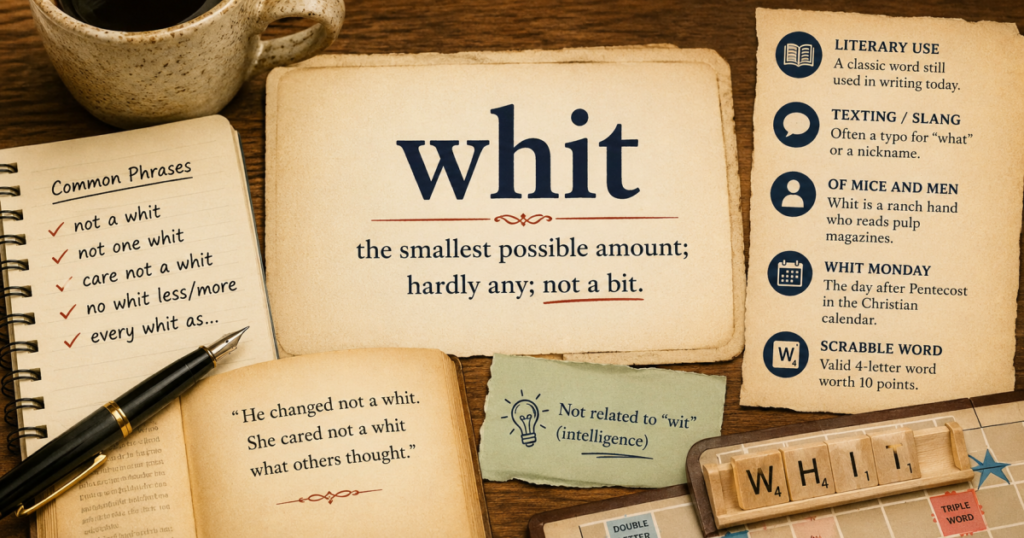
Whit meaning: Whit is a noun that means the smallest possible amount of something. It commonly appears in phrases like “not a whit” and “care not a whit,” meaning not at all. The term originates from Old English and is unrelated to “wit” or “white.” In other contexts, Whit can be a given name, a character in Of Mice and Men, a texting typo for “what,” or an abbreviation associated with Whit Monday.
Key Takeaways
- Whit is a noun meaning the tiniest conceivable amount, roughly equal to “iota” or “bit.”
- It almost always appears in a negative construction: “not a whit,” “not one whit,” or “care not a whit.”
- “Whit” is not related to “wit” (cleverness), even though the two words are often confused.
- “Whit” is a valid, playable word in Scrabble and Words with Friends, worth 10 points.
- In John Steinbeck’s Of Mice and Men, Whit is a minor ranch hand who reads pulp magazines.
- Whit Monday is a Christian holiday the day after Pentecost; it is not a public holiday in the U.S. or Canada.
- In texting, “whit” is sometimes a typo for “what” or short for a name like Whitney.
What Does “Whit” Mean?
Whit is a noun that describes the smallest amount of something imaginable. Dictionaries define it as “the smallest part or particle imaginable,” similar in meaning to “bit,” “iota,” or “jot.” Nearly every use of the word appears inside a negative sentence, since the entire point of “whit” is to say that an amount is essentially zero.
For example, saying “he changed not a whit” means he did not change even a tiny bit; he stayed exactly the same. This pattern shows up constantly in classic literature and modern journalism alike, from Shakespeare’s plays to op-eds published this year.
Whit vs. Wit: Don’t Mix Them Up
One of the most common mistakes with this word is confusing “whit” with “wit.” They sound almost identical, but they mean completely different things.
- Whit = a tiny amount (“not a whit of evidence”)
- Wit = intelligence, mental sharpness, or humor (“a person of quick wit”)
Washington State University‘s usage guide, a well-known reference for English errors, points out that the correct phrase is “not a whit,” not “not a wit,” even though “wit” might feel more familiar to modern ears. The confusion happens because “wit” is a common word today, while “whit” survives almost exclusively in this one idiom.
Where Does “Whit” Come From?
Whit traces back to Old English wiht, meaning “thing,” “creature,” or “being.” Over centuries, that meaning narrowed down to describe a tiny, almost immeasurable amount of something. It’s a doublet of the word “wight,” an old term for a creature or being that still shows up in fantasy fiction today (think “wights” in Game of Thrones).
Despite a common assumption, “whit” is not related to the color word “white,” even though they’re spelled and pronounced almost the same in casual speech. That’s a separate word with its own Old English root, hwīt.
How to Use “Whit” in a Sentence
Because “whit” almost always appears in negative constructions, it helps to see the pattern in action before trying to use it yourself.
Common phrases:
- Not a whit
- Not one whit
- Care not a whit
- No whit less/more
- Every whit as [adjective]
Example sentences:
- “The new manager cared not a whit about employee complaints.”
- “She looked every whit as tired as she felt.”
- “His opinion of the plan hadn’t changed one whit since the meeting.”
- “The rumors didn’t bother him a whit.”
Notice that “whit” functions like a unit of measurement for “amount of caring” or “amount of change,” and that unit is always vanishingly small.
Is “Whit” Still Used Today?
Yes, though it’s considered a literary or slightly old-fashioned word rather than everyday slang. It shows up regularly in published writing, especially opinion pieces, novels, and formal commentary, where writers want a slightly elevated way to say “not at all.”
Recent examples from major publications show the phrase is alive and well: writers for outlets like The New Yorker, Forbes, and Slate have used “not a whit” in commentary published this year to emphasize total indifference or lack of concern. It’s rare in casual conversation, but common enough in written English that most native speakers recognize it even if they wouldn’t use it themselves.
What Does “Whit” Mean in Texting or Slang?
If you’ve seen “whit” pop up in a text message or group chat and it didn’t seem to fit the old-fashioned dictionary meaning, you’re not imagining things. The word has picked up a few casual, informal uses that have nothing to do with “the smallest amount.”
1. A Typo or Shorthand for “What”
The most common modern use of lowercase “whit” in texts is a fast, sloppy way of typing “what.” Because phone keyboards autocorrect inconsistently and people type quickly, “whit” sometimes slips through as a stand-in for “wat” or “what.”
Example:
Friend A: “You still coming tonight?” Friend B: “whit?”
Here, “whit” simply means “what did you say?” There’s no connection to the formal dictionary definition.
2. A Nickname or Given Name
“Whit” is also a common nickname for names like Whitney, Whitaker, or Whitfield. If a capitalized “Whit” shows up at the start of a sentence or as a stand-alone message, it’s most likely someone’s name, not the vocabulary word.
Example:
“Whit said she’ll meet us at 7.”
3. Rarely, Genuine Old-Fashioned Usage
Occasionally, especially among people who read a lot or enjoy showing off vocabulary, “whit” appears in texts with its original meaning intact, usually in a joking or ironic tone, like “I care not a whit lol.”
How to tell which meaning is intended: Check capitalization and context. A lowercase “whit” mid-sentence that could substitute for “what” is probably a typo. A capitalized “Whit” that could be a name is probably a name. And “not a whit” or “care a whit” is almost certainly the classic dictionary meaning.
Is “Whit” a Valid Scrabble Word?
Yes. “Whit” is a legal, playable word in both Scrabble and Words with Friends. It’s worth 10 points in Scrabble before any bonus tiles or squares are applied, based on the standard letter values (W=4, H=4, I=1, T=1).
Because “whit” shares letters with several other short, high-value words, it’s a useful word to remember during play. Other words you can build using the same four letters include “hit,” “wit,” “with,” “hi,” “it,” and “ti.”
| Word | Letters Used | Scrabble Points |
| Whit | W, H, I, T | 10 |
| With | W, I, T, H | 10 |
| Wit | W, I, T | 6 |
| Hit | H, I, T | 6 |
Who Is Whit in Of Mice and Men?
Whit is a minor character in John Steinbeck’s 1937 novella Of Mice and Men. He works as a ranch hand alongside George, Lennie, Slim, Candy, and Curley on the California ranch where the story takes place during the Great Depression.
Whit doesn’t drive the plot, but he plays a specific role in the novel’s themes. He’s known for reading pulp magazines, one of which features a letter from a former ranch hand named Bill Tenner, and Whit takes visible pride in having known someone who “made it” into print. Literary analysts often point to Whit as a smaller, almost comic echo of George and Lennie’s dream of owning land; he chases small brushes with recognition the way George and Lennie chase the idea of a farm of their own.
In Chapter 3, Whit also draws attention to Curley’s wife, asking George if he’s seen her and commenting on her appearance, which helps build the tension that later leads to tragedy in the novel.
Quick Character Snapshot
| Detail | Description |
| Role | Minor ranch hand |
| Key trait | Reads pulp magazines, values small brushes with fame |
| Symbolic function | Mirrors George and Lennie’s dream on a smaller scale |
| Major scenes | Chapter 3 bunkhouse conversation |
What Is Whit Monday?
Whit Monday, also called Pentecost Monday, is a Christian holiday observed the day after Pentecost (also known as Whit Sunday). Pentecost falls 49 or 50 days after Easter, depending on how the count is measured, and commemorates the descent of the Holy Spirit on the apostles, as described in the Book of Acts.
The name “Whit” in “Whit Monday” and “Whit Sunday” comes from the white garments traditionally worn by people being baptized on Pentecost. It has no connection to the “smallest amount” meaning of “whit” discussed earlier in this guide the two words simply look alike.
Is Whit Monday a Holiday in the U.S. or Canada?
No. Whit Monday is not a federal or public holiday in the United States or Canada. Banks, schools, and most businesses operate on a normal schedule. It remains a public holiday in many European countries, including Germany, France, Austria, Denmark, and the Netherlands, where it’s often called by a local name, such as “Pfingstmontag” in Germany or “Lundi de Pentecôte” in France.
Whit Monday at a Glance
| Question | Answer |
| What is it? | Christian holiday the day after Pentecost |
| When is it? | 50 or 51 days after Easter (date changes yearly) |
| Public holiday in the U.S./Canada? | No |
| Public holiday in Europe? | Yes, in many countries (Germany, France, Austria, and others) |
| Origin of the name | White garments worn at Pentecost baptisms |
Comparison: The Different Meanings of “Whit”
| Meaning | Context | Example |
| Smallest amount | Formal/literary writing | “He showed not a whit of remorse.” |
| Typo for “what” | Texting/informal chat | “whit? say that again” |
| A name/nickname | Casual conversation | “Whit is coming over later.” |
| Character in literature | Of Mice and Men | “Whit shows George the magazine.” |
| Part of a holiday name | Religious calendar | “Whit Monday follows Pentecost.” |
Common Misconceptions About “Whit”
- “Whit” and “wit” are interchangeable. They are not. “Whit” means a tiny amount; “wit” means intelligence or humor.
- “Whit” always refers to the holiday. In everyday English, the dictionary meaning (“smallest amount”) is far more common than the holiday-related use.
- “Whit” is modern internet slang. The core meaning is centuries old, dating to Old English. Its texting use as a typo for “what” is a recent, unrelated development.
- “Whit” isn’t a real word, just a typo. It’s a legitimate dictionary word with a long literary history, appearing in Shakespeare, Nathaniel Hawthorne, and Cervantes translations, among many others.
- Whit (the character) is important to the plot of Of Mice and Men. He’s a minor character whose main narrative function is thematic, not plot-driving.
Frequently Asked Questions
Is “whit” a real word?
Yes. “Whit” has been part of the English language since Middle English and appears in major dictionaries, including Merriam-Webster, Cambridge, and the Oxford-based sources used for Scrabble.
Is “whit” the same as “wit”?
No. “Whit” means a tiny amount, while “wit” means intelligence or cleverness. They’re often confused because they sound alike.
Is whit a Scrabble word?
Yes. “Whit” is valid in Scrabble and Words with Friends and scores 10 points based on standard letter values.
What is Whit Monday, and is it a holiday in the U.S.?
Whit Monday is a Christian holiday observed the day after Pentecost. It is not a public holiday in the United States or Canada, though it remains an official holiday in several European countries.
Why is it called “Whit” Monday and not something else?
The name comes from “Whitsunday,” referring to the white clothing worn by people baptized on Pentecost. It’s unrelated to the “smallest amount” meaning of the word.
Is “whit” related to the color white?
No. Despite similar spelling and pronunciation, “whit” (a tiny amount) and “white” (the color) come from two different Old English root words.