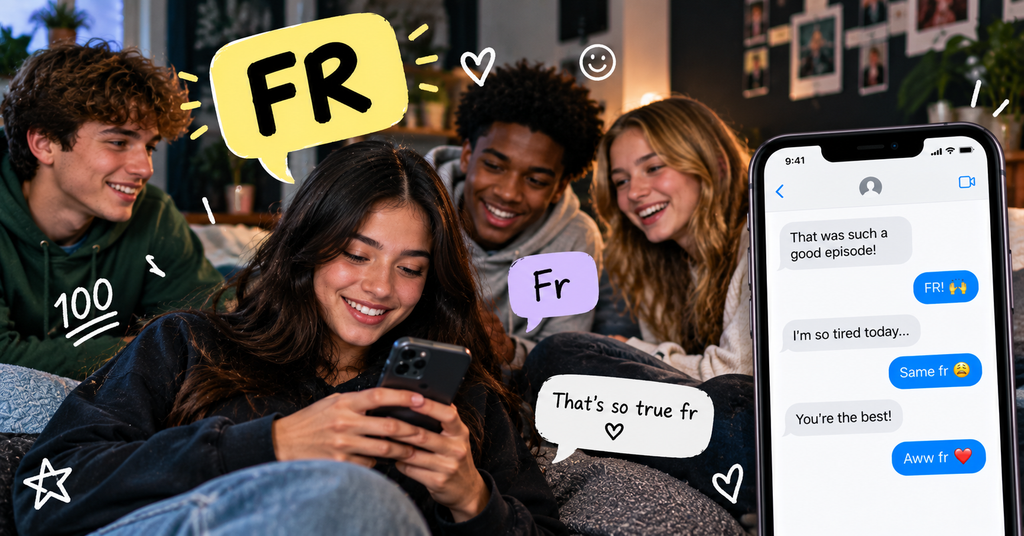
If you have seen “FR” in a text, TikTok comment, or social media post, it usually means “for real.” People use it to show agreement, emphasize that something is true, or make it clear that they are being honest.
For example:
“That exam was so difficult fr.”
This means:
“That exam was seriously difficult.”
FR is common in casual conversations, especially among Gen Z and Gen Alpha users. You’ll see it in text messages, TikTok comments, Instagram captions, Snapchat chats, gaming conversations, and online communities.
FR Meaning in Text
In text messages, FR means “for real.” Depending on the situation, it can mean:
- Seriously.
- Honestly.
- I agree.
- I genuinely mean that.
- I am not joking.
- That is completely true.
The meaning depends on how it appears in the sentence.
| Message | Meaning |
| “That restaurant is amazing fr.” | That restaurant is genuinely amazing. |
| “FR.” | I agree. |
| “FR?” | Really? Are you serious? |
| “I’m tired fr.” | I am seriously tired. |
| “FR tho.” | Seriously, though. |
The lowercase form “fr” and uppercase form “FR” usually have the same meaning. Uppercase letters may add extra emphasis, but they do not create a different definition.
How to Use FR
FR is flexible. It can be used at the beginning or end of a sentence, or by itself as a reply.
FR to show agreement
Someone may send “FR” when they strongly agree with what another person has said.
Example:
“This week has felt so long.” “FR.”
The reply means:
“For real. I completely agree.”
Other possible replies include:
- “Exactly.”
- “Same.”
- “Right?”
- “Facts.”
- “I know!”
FR to emphasize a statement
People often place FR at the end of a sentence to make their opinion sound stronger or more sincere.
Examples:
- “That was the best episode fr.”
- “I need a vacation fr.”
- “This weather is terrible fr.”
- “She is so funny fr.”
- “I cannot stay awake fr.”
In these examples, FR works much like “honestly,” “seriously,” or “genuinely.”
FR to show honesty
FR can reassure someone that a statement is sincere.
Example:
“You handled that situation really well, fr.”
This means:
“I genuinely mean it—you handled it well.”
It is often used when someone wants to make a compliment, confession, or opinion sound authentic.
FR as a question
When written as “FR?”, the abbreviation usually means:
- “Really?”
- “Are you serious?”
- “Did that actually happen?”
- “You are not joking, right?”
Example:
“I got tickets to the concert.” “FR?” “Yes, I just bought them.”
The question mark changes FR from a statement of agreement into a request for confirmation.
What Does FR Mean on TikTok?
On TikTok, FR means “for real.” Users commonly write it in comments, captions, and replies to show that they relate to a video or agree with its message.
TikTok examples
“This is exactly how Mondays feel fr.”
Meaning:
“This is genuinely how Mondays feel.”
“FR 😭”
Meaning:
“This is so true that it is funny or painful.”
“No because fr…”
Meaning:
“Seriously, I completely agree.”
“She was right fr.”
Meaning:
“She was genuinely right.”
FR is especially common under relatable videos, reaction clips, memes, personal stories, and opinions. It can also be used ironically, but the basic meaning remains “for real.”
What Does FR Mean in Gen Z Slang?
In Gen Z slang, FR means “for real” and usually expresses sincerity, agreement, or emphasis. It is a short way to say “seriously,” “honestly,” or “I agree.”
For example:
“Nobody talks about how stressful group projects are fr.”
The speaker is emphasizing that they genuinely believe group projects are stressful.
Although FR is strongly associated with Gen Z and younger internet users, it is not exclusive to one generation. Anyone familiar with online slang may use it in casual conversation.
What Does FRFR Mean?
FRFR means “for real, for real.” It is an intensified form of FR. Repeating “for real” adds extra emphasis and can signal that someone is being especially serious, sincere, or enthusiastic.
Examples of FRFR
- “I’m going to start studying frfr tomorrow.”
- “You need to try that restaurant frfr.”
- “That was the funniest video frfr.”
- “I’m not upset with you frfr.”
- “This is the best game ever frfr.”
The difference is simple:
- FR means “for real” or “I agree.”
- FRFR means “for real, for real” or “I seriously mean this.”
Sometimes FRFR is completely sincere. Other times, people use it humorously to exaggerate a minor opinion.
FR vs. Similar Slang
FR is related to several other internet slang terms, but each one has a slightly different use.
| Term | Meaning | Example |
| FR | For real; seriously or I agree | “That movie was long fr.” |
| FRFR | For real, for real; strong emphasis | “I’m deleting the app frfr.” |
| No cap | No lie; no exaggeration | “That was the best meal, no cap.” |
| Facts | Strong agreement | “Facts.” |
| TBH | To be honest | “TBH, I liked the second movie more.” |
| NGL | Not gonna lie | “NGL, that was impressive.” |
| Deadass | Seriously; genuinely | “I’m deadass tired.” |
| Legit | Truly or genuinely | “That place is legit.” |
FR and “no cap”
FR and “no cap” can both emphasize truth, but they are not the same.
- FR often means “I agree” or “seriously.”
- No cap means “I am not lying or exaggerating.”
Example:
“That was the best pizza I have ever had, fr.”
This emphasizes the speaker’s strong opinion.
“That was the best pizza I have ever had, no cap.”
This emphasizes that the speaker is not exaggerating.
FR and “facts”
Facts is a direct way to agree with someone. FR can also show agreement, but it may additionally mean “honestly” or “seriously.”
Example:
“Being an adult is expensive.” “Facts.”
This means:
“That statement is true.”
“Being an adult is expensive fr.”
This means:
“Seriously, being an adult is expensive.”
How to Reply to FR
The best response depends on the way FR was used.
If someone says FR to agree
You can reply naturally with:
- “Exactly.”
- “I know.”
- “Same.”
- “Right?”
- “Facts.”
- “For real.”
Example:
“This assignment is taking forever fr.” “Same. I’ve been working on it all night.”
If someone asks “FR?”
If the person writes “FR?”, they are probably asking whether your statement is true.
You can answer:
- “Yes, seriously.”
- “I’m not joking.”
- “Yep, it really happened.”
- “No, I’m kidding.”
- “I wish I were joking.”
Example:
“He moved to another country.” “FR?” “Yes, he left last week.”
If FR appears in a serious conversation
A one-word reply may sometimes sound dismissive. If someone shares a serious feeling, add a complete response instead of replying only with “FR.”
Example:
“I’m really stressed about tomorrow.” “FR, exams can be overwhelming. Do you want to talk about it?”
This sounds more supportive than simply replying “FR.”
Is FR Formal or Informal?
FR is informal internet slang. It is suitable for casual texts, social media, gaming chats, and conversations with friends.
Avoid using it in:
- School essays.
- Job applications.
- Professional emails.
- Business reports.
- Official documents.
- Formal customer-service messages.
Instead of writing:
“The meeting was confusing fr.”
Use:
“The meeting was genuinely confusing.”
The full phrase “for real” is also casual, but it is more widely understood in everyday speech.
Does FR Have Other Meanings?
Yes. Like many abbreviations, FR can mean different things in different contexts.
Possible meanings include:
- For real in texting and social media.
- France or French in some location and language contexts.
- Father, when used before a Catholic priest’s name, such as “Fr. James.”
- A technical abbreviation or product code.
- An industry-specific term.
Context usually makes the meaning clear.
For example:
“That outfit looks great fr.”
Here, FR means “for real.”
But:
“I’m traveling to FR next month.”
Here, FR may refer to France, depending on the conversation.
Common Mistakes When Using FR
FR is easy to understand, but a few details can affect its tone.
Using FR in formal writing
FR may look too casual in a professional or academic setting. Use “seriously,” “honestly,” or “genuinely” instead.
Confusing “FR?” with “FR”
These forms have different functions:
- FR usually means “I agree” or “for real.”
- FR? usually means “Really?” or “Are you serious?”
Replying only with FR to an emotional message
A one-word response can sound uninterested if someone is sharing a personal problem. Add a supportive sentence when the topic is serious.
Assuming FR always means agreement
FR often shows agreement, but it can also emphasize a statement or ask for confirmation. Read the surrounding message before interpreting its tone.
Frequently Asked Questions
What does FR mean in text?
FR usually means “for real.” It can express agreement, honesty, seriousness, or emphasis.
What does FR mean in a text message?
In a text message, FR can mean “seriously,” “honestly,” “I agree,” or “I am not joking.” The exact meaning depends on the sentence and punctuation.
What does “what fr mean in text” refer to?
The phrase “what fr mean in text” is asking for the slang definition of FR. In most casual conversations, FR stands for “for real.”
What is FR short for in texting?
FR is short for “for real.” It is a casual abbreviation used in texts, comments, captions, and online chats.
What does FR mean in Gen Z slang?
FR means “for real” in Gen Z slang. It is used to show that someone agrees, is being sincere, or believes something is genuinely true.
What does FR mean on TikTok?
On TikTok, FR means “for real.” It commonly appears in comments and captions to show that a user relates to a video or strongly agrees with it.
What does FR mean from a girl or guy?
FR has the same meaning regardless of who sends it. It usually means “for real,” “seriously,” “honestly,” or “I agree.”
Is FR positive or negative?
FR can be used in both positive and negative sentences. It does not have a fixed positive or negative meaning; it simply adds emphasis or shows agreement.
Positive: “That song is beautiful fr.”
Negative: “That homework was awful fr.”
Is FR rude?
FR is not normally rude. However, replying with only “FR” to someone discussing a serious issue may sound dismissive or unclear. A complete, supportive response is usually better.