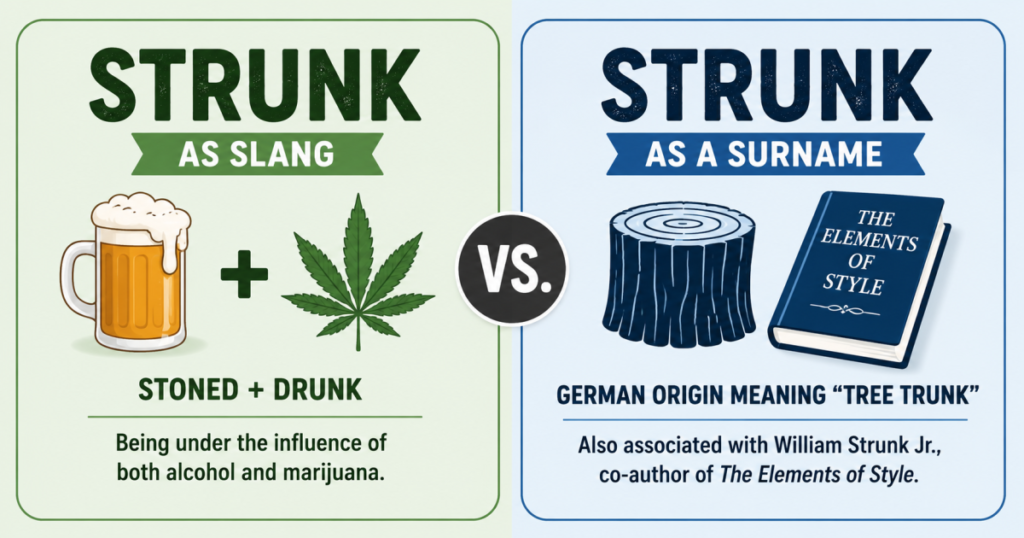
Quick Answer: As slang, “strunk” is an informal portmanteau of “stoned” and “drunk,” describing someone under the influence of both alcohol and marijuana at the same time. Separately, Strunk is a German-origin surname meaning “tree trunk,” and it’s also the name of William Strunk Jr., co-author of the famous writing guide The Elements of Style.
Key Takeaways
- As slang, “strunk” means being both stoned and drunk at the same time, a blend of the two words, dating back to online slang dictionaries from the early 2000s.
- As a surname, Strunk comes from a German word meaning “tree trunk” and is the 4,374th most common surname in the U.S., according to Census data.
- William Strunk Jr. wrote The Elements of Style in 1918, later revised with E.B. White, the short grammar guide many students know as “Strunk and White.”
- Most search results for “Strunk” are actually obituaries, business directories, and law firm listings, because it’s a real last name, not primarily a word.
- There’s a small, low-traffic internet meme claiming “strunk” is a playful misspelling of “stronk” (meaning “very strong”), but this usage is much less established than the stoned-and-drunk slang meaning.
Why “Strunk” Shows Up in Obituaries and Business Listings
If you’ve searched “Strunk meaning” and mostly found funeral home notices, law firm partner pages, or a company called Strunk LLC, that’s not a search glitch. Strunk is a genuine, moderately common surname, especially among families with German ancestry in the United States. According to the U.S. Census Bureau’s surname data, it ranks as the 4,374th most common last name in the country, shared by roughly 8,100 people (source).
That’s why the search results for a plain “Strunk” query skew so heavily toward real people’s names: obituaries, professional directories, and company pages. This guide focuses on the actual meanings and uses of the word itself, separate from any specific person or business named Strunk.
What Does “Strunk” Mean as Slang?
The most established slang meaning of “strunk” is a portmanteau, a word made by blending two other words, combining “stoned” and “drunk” (source). It describes someone who is under the influence of both alcohol and marijuana at the same time.
This usage has been documented across multiple independent slang references for over two decades, including the Online Slang Dictionary (which dates an entry back to 2002) and Urban Dictionary (with entries from 2005 onward). The consistency across sources, spanning more than 20 years, is a good sign that this meaning reflects genuine, ongoing usage rather than a one-off joke.
How “Strunk” Is Used in Slang
Example sentences:
- “After a few beers and a couple of joints, he was completely strunk.”
- “We got way too strunk at that party.”
- “I always feel sick the next day when I get strunk instead of just drunk.”
Related Slang Forms
Slang words built from “strunk” have appeared in some of the same sources, though they’re far less common than the base term:
| Form | Meaning |
| Strunk (adjective) | Stoned and drunk at the same time |
| Strunked | Sometimes used the same way as “strunk”; also separately recorded slang for “beaten” or “outdone” in a competition, an unrelated meaning |
| Get strunk | To become both stoned and drunk during one session |
Is “Strunk” Slang for “Stronk” (Meaning “Strong”)?
You may come across claims online that “strunk” is a playful misspelling of the meme word “stronk,” itself an intentionally misspelled version of “strong” used in image macros and captions about buff animals or cartoonishly powerful characters.
This connection shows up on a handful of newer slang-tracking sites, but it’s worth treating with some caution. Unlike the stoned-and-drunk meaning, which appears consistently across multiple established slang dictionaries over 20-plus years, the “strunk equals stronk” claim currently appears mainly on a small number of low-traffic sites with limited sourcing. It may reflect real usage within a specific online community, but it hasn’t shown the same broad, sustained documentation as the older slang meaning. If you see “strunk” used to describe something powerful or impressive, context should make the intended meaning clear.
Strunk as a Surname: Origin and Meaning
Separate from any slang use, Strunk is a genuine German-origin surname. It derives from a Central and Low German word, related to Middle High German strunc and Middle Low German strunk, both meaning “tree trunk” or “stalk.” The root ultimately connects to a Germanic word meaning “to be stiff,” which fits the image of a rigid, upright trunk.
Surnames describing trees, plants, or natural landmarks were common in medieval Germany, often originally describing where a family lived, such as near a distinctive tree stump or trunk. Families with this surname later emigrated to the United States and other English-speaking countries, which is why “Strunk” appears widely today in American and Canadian phone books, obituaries, and business listings.
Quick Facts: Strunk as a Surname
| Detail | Information |
| Language of origin | German |
| Literal meaning | “Tree trunk” or “stalk” |
| U.S. Census ranking | 4,374th most common surname |
| Approximate U.S. population sharing the name | About 8,100 people |
| Common regions | Areas with German-American settlement history |
Strunk and White: The Most Famous “Strunk” in Writing
For students, writers, and editors, “Strunk” almost always refers to one specific person: William Strunk Jr., an English professor at Cornell University who wrote The Elements of Style in 1918 as a short guide for his students. Decades later, one of his former students, the author E.B. White, revised and expanded the book in 1959. The result, commonly nicknamed “Strunk and White,” became one of the most widely assigned writing guides in American education.
The book’s advice, most famously “omit needless words,” has shaped generations of writing instruction in the U.S. and Canada. It’s also a frequent subject of debate among modern linguists and writing teachers, some of whom argue that its grammar rules are outdated or occasionally inconsistent with how English actually works.
“To Strunk” Something: A Niche Usage Among Writers
Among some writers and editors, “Strunk” occasionally gets used informally as an eponym, a proper name turned into a descriptive term, similar to how “Google” became a verb. To “Strunk” a piece of writing means to edit it down aggressively, cutting unnecessary words in the spirit of Strunk’s famous advice. This usage is niche and mostly limited to editorial or academic circles rather than general conversation.
Comparing the Different Meanings of “Strunk”
| Meaning | Context | Example |
| Slang (stoned + drunk) | Casual conversation, texting | “We got so strunk last night.” |
| Surname | Real people, obituaries, business names | “The Strunk family has lived here for generations.” |
| William Strunk Jr. | Writing, grammar, academia | “Strunk and White is required reading in my class.” |
| “Stronk” meme variant | Niche internet slang (limited evidence) | “That dog looks strunk 💪” |
| “To Strunk” (verb, informal) | Editorial/writing circles | “Can you Strunk this paragraph? It’s too wordy.” |
Common Misconceptions About “Strunk”
- “Strunk only refers to a real last name.” While it is a genuine surname, it also has an established slang meaning unrelated to any specific person.
- “Strunk and stronk mean the same thing.” The “stronk” connection is a limited, less-documented internet claim, not an established equivalent meaning.
- “Strunk is brand-new internet slang.” The stoned-and-drunk meaning has been documented in slang dictionaries since at least 2002, making it more than two decades old.
- “Getting ‘strunk’ is the same as just being drunk.” The slang term specifically implies combining alcohol and marijuana, not alcohol alone.
- “William Strunk wrote The Elements of Style alone.” The original 1918 edition was his work, but the widely known modern version was revised and expanded by E.B. White in 1959, which is why it’s credited to both authors.
Frequently Asked Questions
What does it mean to be “strunk”?
In slang, being “strunk” means being both stoned (high on marijuana) and drunk (intoxicated from alcohol) at the same time. It’s a blend of the two words.
Is Strunk a real last name?
Yes. Strunk is a genuine German-origin surname meaning “tree trunk,” and it ranks as the 4,374th most common surname in the United States, according to Census Bureau data.
Who is Strunk in “Strunk and White”?
William Strunk Jr. was an English professor who wrote The Elements of Style in 1918. The book was later revised by his former student, E.B. White, which is why it’s commonly called “Strunk and White.”
Does “strunk” mean the same thing as “stronk”?
Not officially. “Stronk” is a well-known internet meme spelling of “strong.” A connection between “strunk” and “stronk” appears on a few slang sites, but it’s far less documented than the established stoned-and-drunk slang meaning.
Why do most Google results for “Strunk” show obituaries and business listings?
Because Strunk is primarily a common surname, not just a slang word. Search results reflect real people and companies named Strunk far more often than the word’s slang or literary meanings.