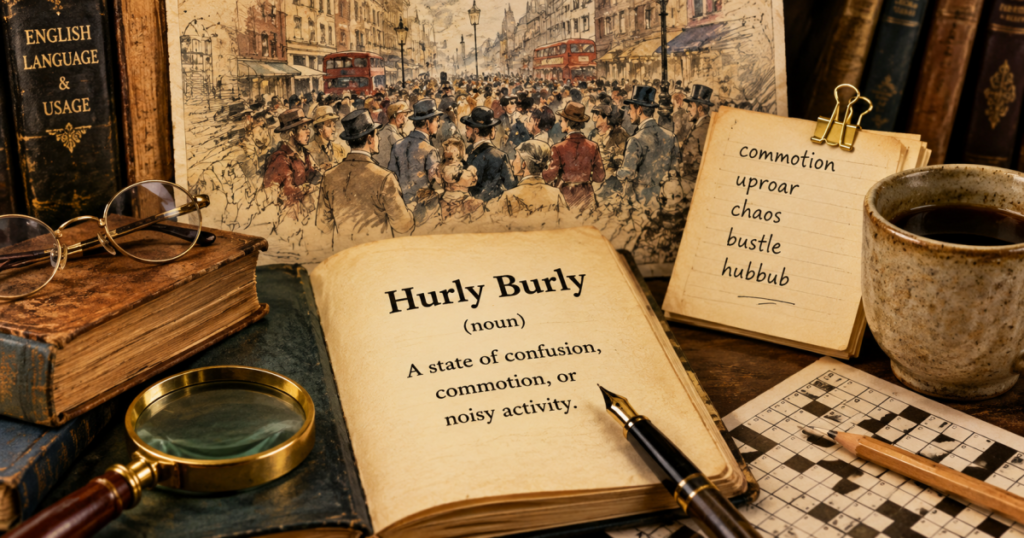
Have you ever come across the phrase “hurly burly” and wondered what it means? While it may sound playful or old-fashioned, this expression has been part of the English language for centuries. Today, it is still used to describe situations filled with noise, confusion, excitement, or disorder.
Whether you encountered the term in a book, a crossword puzzle, a movie title, or everyday conversation, understanding its meaning can help you appreciate the colorful history of the English language.
In this guide, you’ll learn the hurly burly meaning, its origin, examples of usage, synonyms, and common answers related to the hurly burly crossword clue.
What Does Hurly Burly Mean?
Hurly burly refers to a state of commotion, uproar, confusion, or noisy activity. It describes situations where many things are happening at once, often creating disorder or excitement. (Merriam-Webster)
Quick Definition
Hurly Burly (noun): A situation characterized by noise, confusion, disorder, or bustling activity.
Simple Examples
- The shopping mall was full of hurly burly during the holiday season.
- Amid the hurly burly of the airport, she almost missed her flight.
- The children created a hurly burly while playing in the backyard.
In each example, the phrase refers to a noisy and chaotic environment.
Hurly Burly Definition Explained
Many people search for the hurly burly definition because the term isn’t commonly used in everyday conversation anymore.
The phrase can describe:
- Loud and chaotic situations
- Busy environments
- Confusing events
- Exciting public gatherings
- Crowded places with lots of activity
Unlike words that carry a negative meaning, hurly burly can be used both positively and negatively depending on the context.
Positive Example
“The city festival brought a cheerful hurly burly to the downtown streets.”
Negative Example
“The office descended into hurly burly after the computer system crashed.”
Origin of the Phrase Hurly Burly
The phrase has a surprisingly long history.
Early English Roots
Hurly burly first appeared in English during the 16th century. Linguists believe it evolved from words associated with turbulence, disorder, and conflict.
The expression gained widespread recognition through the works of William Shakespeare, particularly in the play Macbeth.
One of the opening scenes contains the famous line:
“When shall we three meet again, in thunder, lightning, or in rain?”
The witches later refer to the end of the battle’s turmoil, often interpreted as the hurly burly of war.
Because of Shakespeare’s influence, the phrase became firmly established in English literature.
How Is Hurly Burly Used Today?
Although somewhat old-fashioned, the phrase still appears in modern writing and speech.
You’ll often find it used in:
- News articles
- Literature
- Historical writing
- Opinion pieces
- Crossword puzzles
- Movie and entertainment titles
Modern Examples
At Work
“The manager remained calm despite the hurly burly of the busy office.”
In Travel
“The hurly burly of the train station made it difficult to hear announcements.”
During Events
“The concert’s hurly burly continued long after the final song.”
Family Gatherings
“The house was filled with the hurly burly of relatives preparing for the wedding.”
Hurly Burly Synonyms
If you’re looking for alternative words with a similar meaning, these synonyms can help.
| Hurly Burly Synonym | Meaning |
| Commotion | Noisy disturbance |
| Uproar | Loud public disorder |
| Turmoil | State of confusion |
| Chaos | Complete disorder |
| Hubbub | Loud noise and activity |
| Clamor | Continuous loud noise |
| Racket | Disturbing noise |
| Bustle | Energetic activity |
| Pandemonium | Wild disorder |
| Frenzy | Intense activity or excitement |
Example Comparison
- The marketplace was filled with hurly burly.
- The marketplace was filled with commotion.
- The marketplace was filled with bustle.
Each sentence conveys a similar idea but with slightly different nuances.
Antonyms of Hurly Burly
Understanding opposites can clarify a word’s meaning.
Common antonyms include:
- Calm
- Peace
- Quiet
- Order
- Serenity
- Tranquility
- Stillness
Example
Instead of the hurly burly of the city, she preferred the peace of the countryside.
Hurly Burly in Literature and Popular Culture
The phrase has inspired numerous creative works.
One notable example is the film Hurlyburly, based on the stage play by David Rabe.
Authors often use the expression to evoke images of crowded streets, battles, political unrest, or energetic celebrations.
Its rhythmic sound makes it memorable and expressive, which is one reason it has survived for centuries.
Hurly Burly Crossword Clue
Many people encounter this phrase while solving crossword puzzles.
Common Hurly Burly Crossword Clue Answers
Depending on the puzzle, possible answers may include:
- Uproar
- Chaos
- Hubbub
- Commotion
- Turmoil
- Racket
- Bustle
- Clamor
The correct answer usually depends on the number of letters required.
Example Crossword Clues
| Clue | Possible Answer |
| Hurly burly | Uproar |
| State of confusion | Chaos |
| Noisy commotion | Hubbub |
| Bustling activity | Bustle |
When searching for a hurly burly crossword clue, it’s helpful to consider synonyms rather than the exact phrase itself.
Is Hurly Burly One Word or Two?
The traditional spelling is:
✅ Hurly-burly (hyphenated)
However, modern usage often appears as:
✅ Hurly burly
Both forms are widely accepted, though dictionaries frequently list the hyphenated version as the standard spelling.
Why Is the Phrase So Memorable?
Many English expressions disappear over time, yet hurly burly remains recognizable because:
- It has a distinctive sound.
- It appears in classic literature.
- It vividly describes chaotic situations.
- It is frequently used in puzzles and word games.
The repetition and rhythm make it easy to remember even if people don’t use it regularly.
Common Mistakes When Using Hurly Burly
Mistake 1: Assuming It Means Anger
While a chaotic scene may involve angry people, hurly burly itself refers to confusion or commotion, not anger.
Mistake 2: Using It Only Negatively
The phrase can describe positive excitement as well.
Example:
“The joyful hurly burly of the parade filled the streets.”
Mistake 3: Confusing It with a Specific Event
The expression describes a condition or atmosphere rather than a particular event.
Examples of Hurly Burly in Sentences
Here are additional examples showing different contexts.
- The hurly burly of the market continued until sunset.
- She escaped the city’s hurly burly for a quiet weekend retreat.
- Amid the hurly burly of election season, facts were often overlooked.
- The restaurant’s lunchtime hurly burly kept the staff busy.
- Tourists enjoyed the vibrant hurly burly of the annual festival.
Frequently Asked Questions
What does hurly burly mean?
Hurly burly means a state of noisy activity, confusion, commotion, or disorder.
Is hurly burly an old-fashioned phrase?
Yes. It originated centuries ago but still appears in literature, journalism, and crossword puzzles.
What is the hurly burly definition?
The definition of hurly burly is uproar, tumult, bustle, or noisy confusion.
Where did the phrase come from?
The phrase dates back to the 16th century and became well known through Shakespeare’s Macbeth.
What is a common hurly burly crossword clue answer?
Common answers include uproar, chaos, commotion, turmoil, and hubbub.
Can hurly burly be used positively?
Yes. It can describe energetic and exciting activity, such as festivals, celebrations, or busy marketplaces.
Final Thoughts
The phrase hurly burly may be centuries old, but its meaning remains relevant today. Whether you’re describing a crowded airport, a lively festival, a chaotic office, or solving a crossword puzzle, the term perfectly captures the idea of noise, excitement, and confusion happening all at once.
Understanding the hurly burly meaning, its history, synonyms, and modern usage not only expands your vocabulary but also helps you recognize one of English’s most colorful expressions. The next time you encounter a scene full of commotion and activity, you’ll know exactly when to call it a hurly burly.